Space and Physics
 PUBLISHED


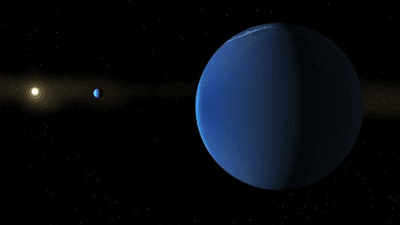


Two planets with almost the lowest densities ever measured have been discovered more than 1,000 light-years away. Although such “super-puff planets” have been seen before, this discovery is particularly unexpected because they both orbit the same star, and are not particularly hot.
Earth has an average density of 5.51 grams per cubic centimeter, narrowly taking the crown as the Solar System’s densest planet over Mercury. The gas giants are all much less dense, being lots of gas around relatively small solid cores, with Jupiter at 1.33 gcm-3 and Saturn famously less dense than water.
It was only to be expected that as we discovered planets orbiting other stars (exoplanets) the range would be extended, but astronomers have been shocked at how far that goes.
In 2022 a planet was found with density so low it was compared to marshmallow. At a density of just 0.27 gcm-3 TOI-3757b is less than half as dense as Saturn, and would comfortably float in your hot chocolate if you could find a bowl big enough.
The universe was just getting started, however, with the subsequent discovery of planets so light they were more similar to cotton candy (fairy floss or candy floss in some countries).
Although we don’t fully understand how these planets got this way, one notable feature is that most of them orbit very close to their star, and the heat apparently puffs them up. That makes at least one example a puzzle, since its orbit suggests it should be, if not cool, at least more similar to Mercury in temperature than the others in its class, which have temperatures of thousands of degrees.
The TOI-791 system adds to the confusion. TOI-791b has a density estimated at 0.038 gcm-3, almost exactly matching the current record-holder, and at 0.047 gcm-3 TOI-791c’s density is still less than 1 percent of Earth’s. Although both orbit closer to their star than Earth does to the Sun, and TOI-791 is quite a luminous star, neither planet is exposed to scorching heat like other super-puff planets.
Despite this, they are the largest planets ever found with densities lower than 0.05 gcm-3. Their masses are what we would expect of rocky planets 2-3 times as wide as Earth, not gas giants with thousands of times the volume.
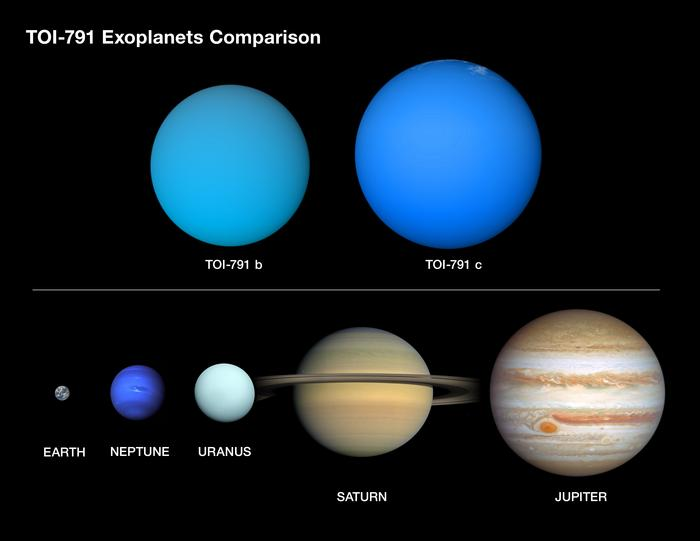
“Only a handful of these super-puffy planets are known, and it is even rarer to find two in the same system. Their extremely low densities make them fascinating targets for understanding how planetary systems form and evolve,” Dr George Dransfield of the University of Oxford said in a statement.
To establish an exoplanet’s density we need to know its mass, based on the movement its gravity produces in the star, and its surface area, from the light it blocks out when passing between the star and us. For some exoplanets we have only one or the other, and can only guess how dense they are.
However, TOI-791b and c were discovered through the drop in starlight collected by the TESS space telescope when they pass between us and their star, since verified through the doppler shift in TOI-791’s light. The system was considered interesting enough to attract the attention of many telescopes.
In particular, Antarctica’s ASTEP telescope took advantage of the star’s southern location from our perspective to capture the whole of transits lasting 11 hours hours during the long polar night to make the size measurements more precise.
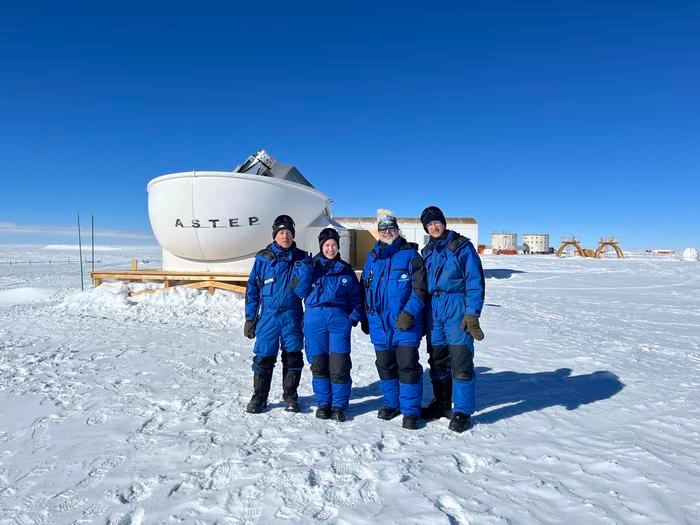
“This system offers a unique laboratory for understanding how super-puff planets form and evolve. We propose to carry out space-based observations using the James Webb Space Telescope to assess if the puffy atmosphere contains carbon-, nitrogen-, and oxygen-bearing species, revealing new insight into how these unusual planets formed,” said Professor Amoury Triaud of the University of Birmingham.
The favored explanation for ultra low-density planets has been that they formed far from the star, where hydrogen and helium are much more common than heavier elements, and then migrated inwards to where the heat puffed them up. For two planets to make that journey suggests they probably did it together, a hunch reinforced by the 5:3 ratio of their orbital periods.
“These multi-planetary systems are complex, with gravitational interactions between the planets that evolve over very long periods,” said Professor Tristan Guillot of Université Côte d’Azur.
That could make explaining the formation process harder, but also more revealing if we succeed.
Some other super puff planets orbit very young stars, and may still be contracting; the authors say TOI-791’s age is unknown, and could be an important piece of the puzzle.
The study is published open access in Monthly Notices of the Royal Astronomical Society.