Space and Physics
 PUBLISHED



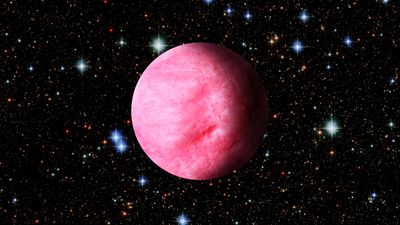


An international team of astronomers has announced the discovery of a truly odd-ball planet. The planet has an extremely low density, so low that it has been compared to cotton candy. It is 50 percent larger than Jupiter but seven times less massive, orbiting its star every 6.25 days. It is called WASP-193b.
The proximity to its star is what makes the planet puff up so much. However, the expansion of the atmosphere on similar planets to this (like the ones in the Kepler-51 system) leaves planetary scientists scraping their heads. These super-puffy planets are truly an outlier when it comes to planets in the galaxy.
"WASP-193b is the second least dense planet discovered to date, after Kepler-51d, which is much smaller," lead author Dr Khalid Barkaoui, a Postdoctoral Researcher at the University of Liège's EXOTIC Laboratory, said in a statement. “Its extremely low density makes it a real anomaly among the more than five thousand exoplanets discovered to date. This extremely-low-density cannot be reproduced by standard models of irradiated gas giants, even under the unrealistic assumption of a coreless structure.”
Different observations were necessary to estimate the size of the planets and their mass. Put together, they suggest that WASP-193b has a density of 0.059 grams per cubic centimeter. Water has a density of 1 gram per cubic centimeter, so WASP-193b would float on water. In the Solar System, only Saturn has a density smaller than water with 0.687 grams per cubic centimeter.
Jupiter is a lot denser: 1.33 grams per cubic centimeter. And Earth is over four times that: 5.51 grams per cubic centimeter.
Gas giants and rocky planets are not just nicknames. And for worlds like WASP-193b, even "gas giant" seems insufficient to describe the puffiness.
“The planet is so light that it’s difficult to think of an analogous, solid-state material,” explained co-author Julien de Wit, professor at Massachusetts Institute of Technology. “The reason why it’s close to cotton candy is because both are pretty much air. The planet is basically super fluffy.”
How such a planet came to be is an utter mystery. A mystery that hopefully has a solution in sight thanks to new observatories such as JWST. Studying its puffed-up atmosphere might reveal something about its past that would allow astronomers to better understand its origin.
“We don’t know where to put this planet in all the formation theories we have right now, because it’s an outlier of all of them. We cannot explain how this planet was formed. Looking more closely at its atmosphere will allow us to constrain an evolutionary path of this planet,” added Francisco Pozuelos, astronomer at the Instituto de Astrofisica de Andalucia.
“WASP-193b is a cosmic mystery. Solving it will require some more observational and theoretical work, notably to measure its atmospheric properties with the JWST space telescope and to confront them to different theoretical mechanisms that possibly result in such an extreme inflation,” concluded Barkaoui.
A paper describing the results is published in Nature Astronomy.