Space and Physics
 PUBLISHED





A meteorite from Mars has plugged a 1.8 billion-year-long gap in the record of the most common form of Martian rock we have been able to sample, providing a unique resource that can help us make sense of the planet’s geological history.
Back in 2011, getting rocks off the surface of Mars and back to Earth was declared NASA's highest scientific priority, but since then, the estimated cost of doing so has spiraled, and a prospective sample return mission was recently canceled because of its hefty price tag, which endangered multiple other NASA missions.
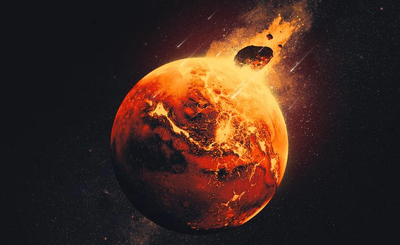
Sometimes, however, the rocks come to us. That's because, now and then, an incoming asteroid slams into Mars hard enough to launch material out of the planet's gravity well, and a tiny fraction of those rocks may eventually make their way to Earth.
Of these, most splash into the ocean or other places we will never find them, making the few that get studied exceptionally precious (so please don’t damage their magnetic fields with hand magnets).
A gap in the record
Unlike the rocks Perseverance has collected for the sample return mission that may never come, we don’t get to pick and choose which bits of Mars arrive as meteorites. More than 90 percent of them belong to a category known as shergottites, but until now there has been an enormous gap in the ages of the shergottites we have found.
Most shergottites are less than 600 million years old, and their igneous structure indicates there was substantial geological activity in the most recent 15 percent or so of Mars’ existence. We also have two shergottite samples that are about 2.4 billion years old, but there are no shergottites for the 1.8 billion years in between.
This raised the question of whether this was just bad luck or whether Martian igneous rock formation stopped for that vast slab of time before restarting.
Now a team led by Boston College’s Professor Ethan Baxter has found a shergottite meteorite from within the middle of that gap. Officially designated (NWA) 13441, the meteorite was found in Algeria in 2019, and a 0.9-gram (0.03-ounce) sample was provided to Baxter’s lab.
“We dated this sample to be 1.273 billion years old, which fills a roughly 2-billion-year gap for which we had no shergottite samples to provide information about magmatic and volcanic activity on Mars,” said doctoral candidate Dylan Seal in a statement.
This part of deep Mars may never have experienced melting since the formation of the solar system
Dylan Seal
The team also found something else. The ratio of neodymium isotopes in the sample was unlike that of any previously studied shergottites, but it was similar to samples from chondrites, meteorites from asteroids that have undergone little geological processing since the dawn of the Solar System.
The authors think this indicates that the material that became NWA 13441 was once buried deep within Mars, where it remained relatively unmixed before being spat out onto the Martian surface.
“The exciting part of our study is that our sample has a chondritic Nd isotope composition, consistent with what would be expected if this part of deep Mars had never experienced melting since the formation of the solar system and Mars,” Seal told IFLScience.
Lacking plate tectonics, it is possible for pockets of Mars's mantle to retain their historical composition to a degree that wouldn't be possible on Earth.
However, the authors can’t entirely rule out an alternative explanation: that the sample is the product of mixing between two magma reservoirs that happened to average out to something like the ancestral state.
Written in stone
You might have noticed that 1.27 billion years, the proposed age for the sample, is quite a bit younger than the age of Mars itself. While that might seem a little odd for a rock composed of the kind of stuff the planet was made from, geologists can only date igneous rocks from the point where they solidified out of magma.
The researchers think (NWA) 13441’s crystallization began near the boundary between the Martian crust and mantle. Then, around 1.27 billion years ago, a volcano spat some of this pristine material out, causing the process to accelerate under cooler conditions on or near the surface, producing the age the authors measured with their samarium-neodymium dating.
Much more recently, an asteroid impact launched (NWA) 13441 on its journey to Earth, but the authors are unable to measure when this was, or how long it sat in the Sahara before being found.
Ironically, given how rare they are, we have previously found two other types of Martian meteorites, nakhlites and chassignites, that are only slightly older than (NWA) 13441. However, while these are interesting as exceptions, the rarity of other meteorites of their types makes them less of a guide to what most of Mars was doing during that long gap than the new find.
“Our goal is to analyze additional isotope systems that will help us better understand how this unique sample relates to other martian meteorites on early Mars,” Baxter said.
The study is published in Geochimica et Cosmochimica Acta.