Nature
 PUBLISHED




When Janet and Stephen Boxall saw a sea turtle on Campwin Beach in Queensland, Australia, they realized this was not a species they had seen before. Months later, they learned it was an endangered olive ridley turtle, never known to nest on Australia’s east coast despite decades of observations. In the process, they may have rescued an expansion into new territory.
These are bad times for sea turtles. Besides the problems of overfishing and ocean plastics, sea turtles, whose sex is determined by the temperature at which their eggs are incubated, are particularly threatened by global heating.
However, one thing in the shelled ones’ favor is how much many humans love them – and the willingness of some beachgoers to protect their eggs and young, increasing the numbers of them that make their initial dash to the sea alive. One particularly fortunate crowd is what may be the first olive ridley turtles to hatch on Australia’s east coast for decades, perhaps longer.
Sea turtles lay large clutches of eggs, but few survive to adulthood. A large portion of the problem comes among those that, for one reason or another, never make it to the sea for their first swim. Mackay and District Turtle Watch (MDTW) is made up of volunteers who try to give the green and flatback turtles that hatch on nearby beaches a better chance.
“It was a series of accidental discoveries,” Janet Boxall, an MDTW volunteer, told IFLScience. “We were checking the beach for turtle tracks at 4:20 in the morning when we saw a small turtle returning to the water. We immediately noticed that it had an alternate (asymmetrical) gait, not using the breaststroke (symmetrical) action as flatbacks and greens do.”
The light was too low to get a useful photograph, but the pair thought they were seeing a young loggerhead. “We were quite excited as they only rarely nest in our area,” Boxhall added. “The nest was also unusual so we assumed at first that she did not nest but only messed around in the sand. We took extensive photos of the tracks and the nest.”
The Boxalls contacted a more experienced volunteer, Lynette Gallagher, who, after some searching, found an egg chamber with 90 eggs. Perhaps because the turtle was unused to the local tides, these had been laid too close to the water, and would have been drowned at the next high tide. The volunteers moved them further up the beach. A forthcoming cyclone led to a second relocation.
The Boxalls then went on holiday, but Janet’s sister Shirley Sidey watched over the nest and witnessed 34 hatchlings make it to the water on their own. Knowing that some turtles lack the strength to break free from the nest, Sidey went digging and found 12 alive, still trapped. She released these where they could reach the water.

Sidey took photographs, but when comparing them with loggerhead images online noticed a mismatch – particularly when looking at the shape of the body and the side scales. After consulting more widely, the photos eventually reached Dr Col Limpus, Australia’s leading sea turtle expert, who confirmed these were olive ridley turtles (Lepidochelys olivacea), based on a combination of gait, egg size and number of side scales.
This was quite a shock. Although olive ridleys are known to inhabit the waters of the Great Barrier Reef, they have never been reported nesting on Australia’s east coast. The nearest nesting site is south of Weipa on Queensland’s west coast, 2,000 kilometers (1,200 miles) from Campwin. Indeed, reports of nesting are rare throughout the western Pacific – the most abundant locations are in India and the Americas, each an ocean away.
Finding any species so far from home would be a shock, but it is particularly unexpected for an olive ridley, a species famous for synchronizing their egg-laying so that the young will hatch together for safety.
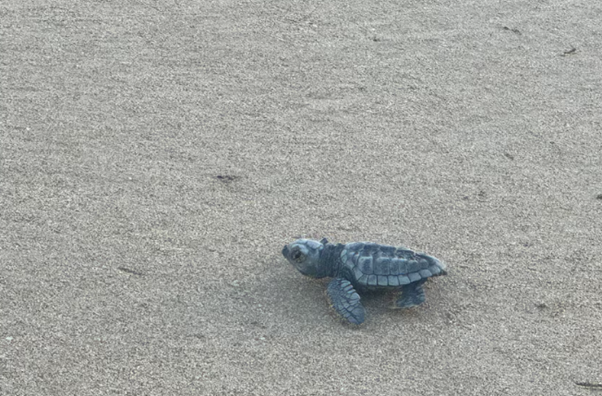
Whether this is a freak event, something that has been happening for a while without anyone noticing, or the start of an expansion of the olive ridley's range remains unknown. Volunteers up and down the coast will be watching. Had it not been for MDTW intervention, the nest would certainly have drowned, presumably snuffing out any chance of olive ridleys establishing themselves in the area.
Olive ridleys are the most common sea turtle in the world, but even they are categorized as vulnerable as a result of mass exploitation off Mexico and the dangers all sea turtles face.
[H/T The ABC]
Correction: An earlier version of this article stated that Sidey released the hatchlings into the water. It has been corrected to state that Sidey released them where they could reach the water.