Nature
 PUBLISHED
 1
1


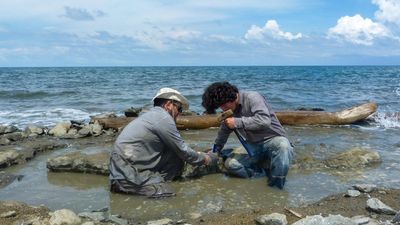


Traces of ancient DNA appear to have been found within the 6-million-year-old fossil bones of an extinct turtle. This is staggeringly old evidence of DNA and may suggest that genetic material can last much longer than previously appreciated.
Found along the Caribbean coast of Panama, the fossil consists of a broken shell, but the remaining skeleton has since been lost. It belongs to a species of turtle in the genus Lepidochelys, which still lives today in the form of Kemp's ridley sea turtles and Olive ridley sea turtles. The exact species of the fossil is not certain, although it’s suspected to have belonged to a newly discovered extinct species.
In a recent study, scientists explain how they may have found traces of DNA locked away in the turtle’s preserved bone cells, called osteocytes. Viewing the osteocytes under a microscope, the team noticed “nucleus-like” internal structures. Since the nucleus is the organelle in cells that houses DNA, they carried out a test for the presence of the genetic material, and, to their surprise, it tested positive.
“Within the entire vertebrate fossil record on the planet, this had only been previously reported in two dinosaur fossils, including one of Tyrannosaurus rex,” Dr Edwin Cadena, study author from the Universidad del Rosario in Bogotá, Colombia, and a research associate at the Smithsonian Tropical Research Institute in Panama, said in a statement.
.jpg "piece of fossil turtle carapace on black background")
DNA naturally breaks down over time, which is unfortunate when you consider how much information about the distant past it could contain. While this test result is pretty good evidence that genetic material is within the turtle shell osteocytes, it’s not direct proof. To confirm the presence of genetic material, the researchers would have directly identified the DNA and sequenced it.
The oldest DNA that has been recovered and sequenced came from a 1.2 million-year-old mammoth found buried in the Siberian permafrost. At five times the age of this, the evidence of DNA in the ancient turtle suggests that genetic material might potentially remain preserved for millions upon millions of years, even in warmer environments that aren’t friendly to DNA molecules.
“These data demonstrate the potential for DNA to persist in specimens that are both millions of years old and are from lower latitudes, which challenges traditional paradigms of biomolecular preservation,” the study authors write.
Understanding the genetics of the ancient Lepidochelys turtle would be especially interesting since very little is known about their history or evolution. Just seven species of sea turtles live today, and most are facing a myriad of threats to their existence.
“The Caribbean fossils from Panama that we have managed to rescue over the years are helping to rewrite the history of marine vertebrates of the Isthmus,” explained Carlos De Gracia, study co-author and a doctoral fellow affiliated with Smithsonian Tropical Research Institute who is funded by Panama’s Office for Science and Technology.
The study is published in the Journal of Vertebrate Paleontology.
An earlier version of this article was published in October 2023.