Nature
 PUBLISHED
 3
3


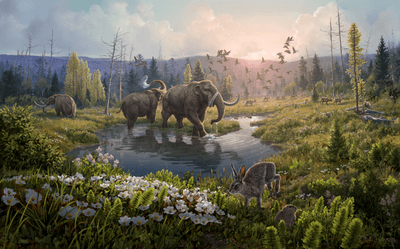


The oldest fragments of DNA ever discovered have been found in the permafrost of northern Greenland, enabling scientists to paint a picture of a verdant landscape teeming with life in the distant past. Dated to at least 2 million years ago, the genetic material belonged to more than 100 different plant species and the animals that fed on them, including mastodons and reindeer.
Prior to this incredible discovery, the most ancient DNA ever sequenced belonged to a 1.2-million-year-old Siberian mammoth. Describing their staggering find in a study, the researchers explain that the environmental DNA recovered from Greenland probably survived for so long by binding to minerals in clay.
The genetic material was found at the Kap København Formation, which sits in a part of Northern Greenland that the researchers describe as a “polar desert”. However, during the Late Pliocene and Early Pleistocene, the region experienced temperatures that were between 11 and 19°C (51.8 to 66.2°F) higher than they are today.
Describing the plant species identified in the ancient DNA, the study authors explain that Kap København was once “an open boreal forest ecosystem with mixed vegetation of poplar, birch and thuja trees, as well as a variety of Arctic and boreal shrubs and herbs.”
“The DNA record confirms the presence of hare and mitochondrial DNA from animals including mastodons, reindeer, rodents and geese, all ancestral to their present-day and late Pleistocene relatives,” continue the researchers.
Interestingly, reindeer and mastodons are absent from the local fossil record, so the detection of their DNA fills in some of the gaps in our knowledge of the Arctic ecosystem at this primordial juncture. Furthermore, the mastodon DNA at Kap København was distinct from that of other Pleistocene mastodons, suggesting that the Greenland proboscidean may have been an older, unknown species.
Meanwhile, the presence of horseshoe crab and green algae DNA indicate that the waters surrounding northern Greenland were much warmer than they are today, and could host organisms that are no longer able to live so far north.
While the team couldn’t definitively determine the age of the genetic material, minerals found in the same layer of sediment contained signals reflecting changes in the Earth’s magnetic field. This enabled the researchers to conclude that the environmental DNA was at least 2 million years old.
“The ancient DNA samples were found buried deep in sediment that had built-up over 20,000 years. The sediment was eventually preserved in ice or permafrost and, crucially, not disturbed by humans for 2 million years,” explained study author Kurt Kjær in a statement.
Having teased out the secrets contained in this DNA, the researchers have at long last brought to life the ancient ecosystem of Kap København. Unlike the frozen wasteland of today, this prehistoric landscape was home to a “unique, ancient open boreal forest community intermixed with Arctic species, a community composition that has no modern analogues.”
The study is published in Nature.