Nature
 PUBLISHED


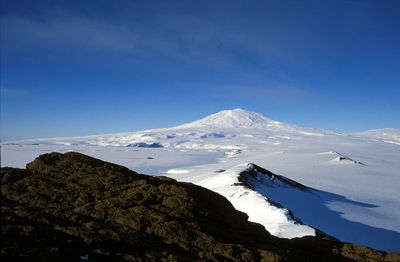


What’s the first thing that comes to mind when you think about Antarctica? Is it the great expanse of white, or perhaps the towering icebergs, or even just the biting cold winds? Or maybe you think about the continent’s most famous waddling inhabitants – Emperor or Gentoo penguins. Or perhaps it’s the incredible volcanoes that hide within this southernmost landmass, one of which is known to spew showers of crystallized gold onto the surrounding landscape.
Antarctica has a surprising number of volcanoes hidden within its desolate landscape. In fact, there are over 138 subglacial volcanoes in West Antarctica and Marie Byrd Land alone, most of which are dormant. However, around eight or nine of these volcanoes are believed to be active.
This relative inactivity may be in great contrast to the past. In 2022, researchers in Copenhagen found that ice cores taken from Antarctica suggest the continent was ravaged by gigantic volcanic eruptions during the last Ice Age.
Today, the most violent volcano in Antarctica is Mount Erebus, named after HMS Erebus by the polar explorer Sir James Clark Ross in 1841 – this is the same vessel that disappeared during the ill-fated Franklin Expedition few years later.
Mount Erebus, which is located alongside two other volcanoes on Ross Island (you can guess who that is named after), is 3,764 meters (12,448 feet) tall, making it the second-largest volcano in Antarctica (Mount Sidley is the highest).
If you were to look directly down into Erebus’s caldera, you’d see a glowing spot at its base. This is a broiling lava lake that since 1972 has contributed to Erebus’s aggressive and weirdly valuable sputterings.
Every day, the volcano spews out plumes of gas and steam that contain tiny crystals of metallic gold that are no more than 20 micrometers in size.
In just one day, the mountain can release around 80 grams of gold, estimated to be worth around $6,000, which gets dispersed across a wide area. Scientists have even found traces of the gold particulate in ambient air around 1,000 kilometers (321 miles) away.
Mount Erebus is part of the Pacific Ring of Fire, a roughly 40,234-kilometer (25,000-mile) horseshoe-shaped chain of volcanoes that circles the Pacific Ocean. This is a geologically volatile area, tracing the convergent points of several tectonic plates, including the Eurasian, North American, Juan de Fuca, Cocos, Caribbean, Nazca, Antarctic, Indian, Australian, and Philippine plates (as well as some smaller ones).
As the plates continuously slide, collide, or subduct with one another, they produce volcanic eruptions and earthquakes across the boundaries where the plates meet. These fault lines are responsible for around 90 percent of the world’s earthquakes and are home to roughly 75 percent of the planet’s volcanoes.
As Antarctica’s ice continues to melt because of global warming, there is a chance that we will see more volcanic activity from the polar region in the future.
Recent research suggests that the accelerated ice melt could reduce pressure on the continent’s subterranean magma chambers, leading to more eruptions. This could possibly create a feedback loop where the increased volcanic activity leads to accelerated ice cover melting, adding to rising sea levels.
“Under these conditions, we find that the removal of an ice sheet above a volcano results in more abundant and larger eruptions, which may potentially hasten the melting of overlying ice through complex feedback mechanisms,” the authors explained in their 2024 paper.
As such, we can expect more gold to be spewed out onto Antarctica’s landscape in the future, but perhaps at a greater cost than any should be willing to pay.