Nature
 PUBLISHED


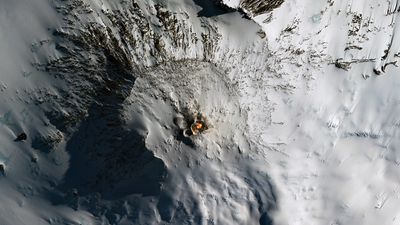


There are dozens of volcanoes in Antarctica, but one of the most ferocious volcanoes on the continent is Mount Erebus. It’s the tallest active volcano in Antarctica – with a summit height of 3,794 meters (12,448 feet) – and the southernmost active volcano on Earth.
Named after the personification of darkness in Greek mythology, it's said Mount Erebus was erupting when Captain Sir James Clark Ross first set eyes upon it in 1841. It boasts a permanent lava lake that may be miles deep and has been bubbling since at least 1972. It stays red-hot even in winter, making it one of just five known lava lakes to do so across the planet.
Mount Erebus also stands out for a curious discovery made by scientists studying its gusts of gas. The plumes are loaded with tiny crystals of metallic gold, no larger than 20 micrometers. Over the course of a single day, it's estimated that the volcano spews out around 80 grams (2.8 ounces) of gold – that's worth around $6,000.
The gold dust travels far and wide. Antarctic researchers have detected traces of the gold in ambient air up to 1,000 kilometers (621 miles) from the volcano. The volcano regularly pumps out plumes of gas and steam. In past bouts of volcanic activity, it has been known to eject boulders of partially molten rock known as “volcanic bombs”.
In spite of all the steamy volcanic action, Mount Erebus is also covered in ice caves. The winding networks were whittled away by gases escaping from the volcano, making them fumarolic ice caves. The extreme conditions within the caves make them a hotspot for studying extremophiles, and Erebus’s caves have been found to be home to 61 species of fungi.
Their discovery in 2013 was believed to be the first report of a fungal community setting up camp in a dark oligotrophic volcanic ecosystem in Antarctica. The fungi are associated with skin surfaces of animals, needing a high lipid content to grow, which the researchers said indicated they are likely evidence of human contamination.
The caves have been visited by scientists and field parties as far back as the Heroic Age of Antarctic Exploration back in the 20th century. Warren Cave is among the most visited, near an established field camp called Lower Erebus Hut, and sits around 300 meters (984 feet) from the volcano’s rim.
How to get there: Heading for Antarctica is a good start, then you can take in the towering Mount Erebus from the safety of a cruise.
This article first appeared in Issue 28 of our digital magazine CURIOUS. Older issues of CURIOUS are free for all users. To access new issues, become an All Access Member.