Nature
 PUBLISHED
 1
1


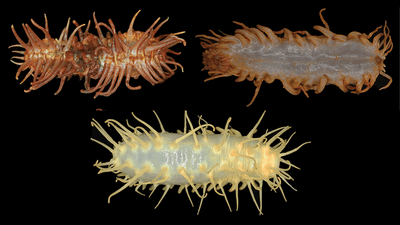


We know by now that the deep ocean is full of frankly bizarre-looking animals like Barbie pigs and funky things with tentacles, and we love it. Now deep-sea sea cucumbers are getting in on the act, with three new species discovered in the South China Sea.
Five scientific expeditions from 2018-2023 were taken using the crewed submersible vehicle Shenhaiyongshi. The submersible went to depths of between 1,340 and 3,806 meters (4,396-12,487 feet), where it carefully scooped up specimens of yellowish white and orange spiky-looking creatures.
The new species of sea cucumbers have been named Oneirophanta idsseica, O. brunneannulata, and O. lucerna and can be told apart from each other by the number of tube feet on their bodies, of which they have quite a few. The species O. idsseica is given the common name the IDSSE sea cucumber after the Chinese research center the Institute of Deep-Sea Science and Engineering (IDSSE), of which both study authors are members.

The team also saw a known species, O. mutabilis mutabilis, for the first time in an area known as the Mariana fore-arc and they managed to spot Deima validum validum for only the second time in the South China Sea.
Over the course of these expeditions 11 specimens were collected, which all belong to the genus Oneirophanta. These 11 represent three new species, bringing the total number of species in the genus up to six.
To come to this conclusion the team took careful images of these animals and examined them with a scanning electron microscope, and performed DNA analysis.
One thing these three new species have in common is tube feet. Tube feet can be used for everything from locomotion to feeding and even to attach themselves to substrate on the sea floor. O. idsseica has between 40 and 50 pairs of tube feet in the middle of its body, while O. brunneannulata has 37 pairs and O. lucerna has only 11-14 pairs of tube feet on each body side.

The team think that there may be even more species in the Pacific Zone and that more research is needed to explore the species diversity and distribution of these unusual animals.
The study is published in ZooKeys.