Nature
 PUBLISHED


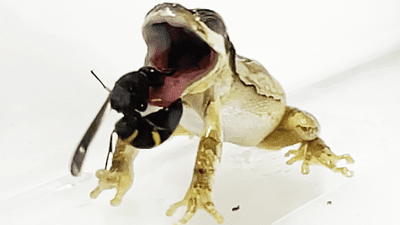


Describing your junk as a weapon is a pretty undesirable trait in humans, but for wasps, it could be a lifesaving adaptation. New research has found that the mason wasp got pretty creative when it cooked up its genital structures, evolving to possess spiky bits that double up as a defense mechanism against predators like frogs.
The mason wasp, Anterhynchium gibbifrons, revealed its unique talents by doing what wasps do best: stinging someone. Co-author on a new paper, Misaki Tsujii of Kobe University, Japan, was studying these insects when one evidently got cross and “stung” her. This was unusual, however, because the wasp was a male.
Stingers developed from ovipositors in the ancestors of modern wasps and bees, so only female insects have them. This means that if you’re enjoying a picnic and get injected by something winged and venomous, it’s usually a female. While some males have pseudostingers for clout, they weren’t thought to cause an actual sting, which is why Tsujii’s experience was odd.

“Surprisingly, the male ‘sting’ caused a pricking pain,” said co-author Shinji Sugiura in a statement seen by IFLScience. “Based on her experience and observations, I hypothesized that the male genitalia of A. gibbifrons function as an anti-predator defense.”
To find out just how deadly the males’ “weapons” were, the researchers pitted them against tree frogs to see if and how they employed their spiky genitals against predators. The predator and prey were put into an arena together to see if the frogs tried to attack, and how successful they were. The rounds revealed that frogs had to spit out genital-wielding males in over a third of the attempts to swallow them, and that they were being repeatedly “stung” with their genitalia as it happened.
Removal of the wasps’ genitals resulted in them being gobbled up, demonstrating the significance of their junk in avoiding being eaten. The genital spikes are known as pseudostings, but until now it wasn’t known that they played a big role in predation events.
“The genitalia of male animals have frequently been studied in terms of conspecific interactions between males and females but rarely in terms of prey-predator interactions,” concluded Sugiura. “This study highlights the significance of male genitalia as an anti-predator defense and opens a new perspective for understanding the ecological role of male genitalia in animals.”
The study was published in Current Biology.