Nature
 PUBLISHED
 2
2


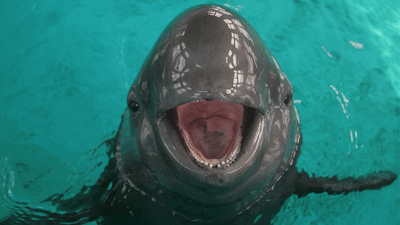


Habitat loss, pollution, poaching, climate change – the list of threats against Earth’s species seems only to be growing. In the midst of these struggles lives a small population of critically endangered freshwater porpoises: meet the Yangtze River finless porpoise (Neophocaena asiaeorientalis asiaeorientalis).
As the name suggests, this porpoise species lives in China's Yangtze River and has a population of just 1,012 individuals according to the WWF. This is a subspecies of the narrow-ridged finless porpoise (Neophocaena asiaeorientalis) which lives around Japan and coastal China, there is also the East Asian finless porpoise or Sunameri (Neophocaena asiaeorientalis. sunameri). The world's most endangered marine mammal is the vaquita, found in Mexico, a species thought to only have a population of around 10 left.
“The news has not been good,” Judy A. Takats, a lead of river basin stewardship at World Wildlife Fund (WWF) told The Dodo. “The Yangtze finless porpoise was once a common sight, but its population has decreased an average of 13.7 percent annually in recent years [...] If these threats were not eliminated or minimized, it was thought the porpoise may become functionally extinct by 2025.”
The porpoise previously shared this habitat with another species: the Yangtze River dolphin, also known as the Baiji, which was declared extinct in 2006. The porpoise is also found in two lakes that connect to the Yangtze River, the Dongting and the Poyang.
The species lacks the dorsal fin that is characteristic of dolphins and whales. Its streamlined body measures around 2 meters (6.5 feet) and they weighs around 100 kilograms (220 pounds) according to Whale and Dolphin Conservation.
One of the main threats to this species comes from fishing. Overfishing reduces the number of prey species available to the porpoise, while they are also frequently tangled up in fishing equipment or even struck by boats.
Another threat to this species is habitat destruction caused by the sand industry. The Natural History Museum London writes that sand is thought to be the world’s most extracted natural resource after water, heavily impacting the porpoise's natural home.
A 2023 study looked at the ecological impacts of sand mining on the porpoises and found that the mining practices both prohibited the porpoises' movements and also reduced important shoreside habitats that were used by the porpoises for foraging and also as nurseries.
In positive news, the illegal sand mining was closely monitored in 2017 leading to a suspension. "The suspension of sand mining in 2017 was a very positive move, and could give this important ecosystem a chance to recover," Richard Sabin, the Museum's Principal Curator of Mammals told the Natural History Museum. "It shows that nature can be given room to thrive even in one of the world's most rapidly industrializing countries, and hopefully the Yangtze finless porpoise will start to recover."
In 2020, the first Yangtze finless porpoise that was born in captivity was released back into the wild. The four-year-old female was named Bei Bei. The team from the Chinese Academy of Science hopes that she will go on to mate now that she has returned to her wild home.