


 Nature
 PUBLISHED


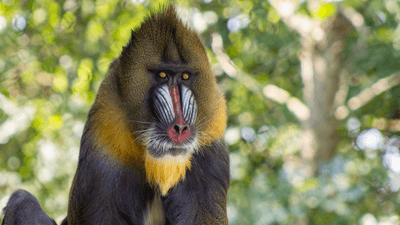


Wander into the wrong bit of forest in Gabon’s Lopé National Park and you could find yourself surrounded by a troop of over 800 primates. Here, mandrills are known to roam the forest in enormous groups called “hordes,” and suffice to say, it’s not a party you want to crash with your puny human teeth.
Native to the rainforests of central Africa, mandrills (Mandrillus sphinx) are the largest monkeys in the world. They may be mistaken for apes due to their apparent lack of tail (the easiest way to tell a monkey from an ape is to see if it has a tail), but mandrills are Old World monkeys and do actually have stubby little tails. They also exhibit pretty extreme sexual dimorphism, meaning the males look very different from the females.
It’s not hard to spot the difference. The males’ faces are plastered in a rather dramatic display of blue, red, and yellow (if you’re a Lion King fan, then yes, this is indeed Rafiki’s species). Not only are they massive, but Africa Geographic reports they aggregate in the largest known groups of any non-human primate species.
Mandrill males also stand out from the females for their gaping mouths and enormous teeth. The biggest of their gnashers can be over 5 centimeters (2 inches) long (and when it comes to making baby mandrills, tooth size is everything). So, does that impressive dentistry mean they’re voracious carnivores? Not really.
Mandrills are omnivores who enjoy everything from fruit and fungi to insects and small reptiles. Sounds pretty chill, right? That is, until they get into a fight.
Mandrills will attack other animals and each other if they are threatened or competing for resources or mates. The males are dangerous on their own owing to their large size – the heaviest on record are over 50 kilograms (110 pounds) – but even female groups can hold their own despite their comparatively smaller size.
A 2006 paper detailed a Very Bad Day for one male mandrill that was incapacitated after a fight with another male. As if things weren’t bad enough, he was then set upon by a group of females. When another male tried to participate in the fray, he was chased away by the females, adding weight to the idea that female coalitions sometimes exclude unwanted males from large groups like the enormous “hordes” of mandrills you find out in Gabon.
Impressive work, mandrills, but you’ll excuse me if I take an alternative route home.


 1
1