Space and Physics
 PUBLISHED
 1
1


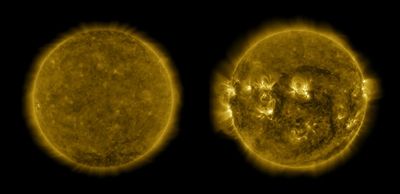


The Sun undergoes a cycle of activity that lasts about 11 years, experiencing a minimum of activity and a maximum of activity. The cycle affects more than just the Sun, so it is important that we monitor and understand it. A new approach has revealed that the reason why individual minima are different might be found deeper inside the Sun.
The team analyzed more than 40 years’ worth of seismic data from the Sun. There are soundwaves going through the interior of the Sun, creating some distinctive patterns. One of these is a clear soundwave glitch caused by these shakes crossing regions where helium is doubly ionized, meaning it has lost both its electrons.
Comparing the solar minima at the end of Cycles 21, 22, 23, and 24, they found that the one between Cycle 23 and Cycle 24 (2008/2009) showed different internal conditions. The "helium glitch" was much larger that time around, and the minimum was significantly quieter than the other three.
The Sun also exhibited a higher wave speed in its outer layers. This implies higher pressures and temperatures, and lower magnetic fields. The Sun’s magnetic field is linked to the cycle, as the poles flip around every maximum of activity (although the two processes don't exactly match up).
"For the first time, we've been able to clearly quantify how the sun's internal structure shifts from one cycle minimum to the next. The sun's outer layers subtly change across activity cycles, and we found that deep quiet minima can leave a measurable internal fingerprint," Professor Bill Chaplin, from the University of Birmingham, said in a statement.
The findings provide new insights into the solar cycle, not based on the number of sunspots, as it is usually tracked, or on solar magnetism. This could also allow us to predict the behavior of solar cycles in the future. The next minimum is expected to happen in 2030.
"Revealing how the sun behaves beneath its surface during these quiet periods is significant because this behavior has a strong bearing on how the activity levels build up in the cycles that follow," explained lead author Professor Sarbani Basu, from Yale University.
Asteroseismology is not limited to our Sun. We can measure the oscillations of other stars as well, so this work could provide a new look at the behavior of suns in other solar systems.
"Our work demonstrates the power of long-term stellar seismic observations. With upcoming missions such as the European Space Agency's PLATO, the techniques used in this study could be applied to other sun-like stars, helping us to better understand how their activity changes and how they influence their local environments, including any planets they may host," added Professor Chaplin.
The study is published in the Monthly Notices of the Royal Astronomical Society.