Space and Physics
 PUBLISHED


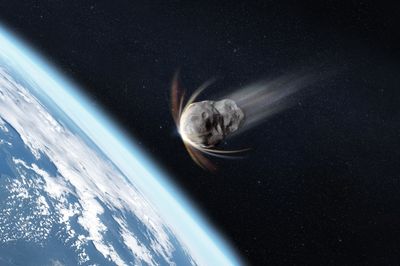


Between February and April it’s fireball season, a period when our planet appears to be traveling across a slightly denser debris field, leading to extremely bright meteors burning through the sky. This year it has appeared to be particularly apparent as a phenomenon, with a flurry reported across Europe and the United States. Some astronomers have argued that there is an unexplained increase in activity. Not everyone agrees, though.
In the last few weeks, there’s been a fireball over Germany, with meteorites hitting a roof; one over France and Spain; a fireball in Ohio; two across California in the same day; one over Michigan; one over Georgia; and one over Texas that dropped a meteorite the size of a cantaloupe through a home in Houston. Is this unusual? Probably not, but with some uncertainties.
As we said, fireball season sees an increase in activity, but maybe there is something extra going on. According to analysis published by the American Meteor Society (AMS), the first three months of this year appear to be outliers compared to data collected by the AMS in previous years. Based on the trajectories suggested by the witnesses, there has been an increase in fireballs from the same region of the sky, the so called antihelion radiant – basically, from the direction opposite the Sun.
There has also been an increase in loud events, a proxy for the mass and size of these fireballs. Thirty out of 38 events with more than 50 reports had a sonic boom. The number of reported mass sightings is also higher than in previous years. While the number of total events seems only to be a bit larger than average, events with more than 50 witnesses and those with over 100 witnesses have both doubled.
The AMS report suggests that the effect goes beyond fireball season activity and argues that it has no geographical bias, since these fireballs have been reported in both Europe and North America. We have seen astronomers and other experts disagreeing with this conclusion.
The data is still based on individuals reporting the events. Many of the fireballs fell over densely populated areas, so it would be interesting to see a per capita report. People might also now be equipped with the knowledge that it’s important to report these events, following famous cases like Winchcombe. The AMS also suggests that AI chatbots might be suggesting reporting it if people search information on fireballs after witnessing an event.
NASA, too, doesn’t think we are seeing an increase in actual events, and so far the same period in 2025 had a lot more energetic events compared to these last three months.

 1
1