Space and Physics
 PUBLISHED





A rare daytime fireball was spotted by many people yesterday across the US Midwest, burning brightly in the sky before falling apart. There is a good chance that this object has left some meteorites behind, and NASA Meteor Watch has an estimated area where they might have ended up.
In the morning of March 17, local time, witnesses reported a bright fireball entering the atmosphere above Lake Erie. It was witnessed from both the United States and Canada before falling apart across Ohio.
NASA estimates the object to be around 2 meters (6 feet) and possibly around 6 tons. This would make it a small asteroid rather than a meteoroid. Still, according to the space agency, “Signatures of falling meteorites are seen in data from three weather radars, KCLE (Cleveland), the Cleveland airport radar TLVE, and KPBZ (Pittsburgh).”
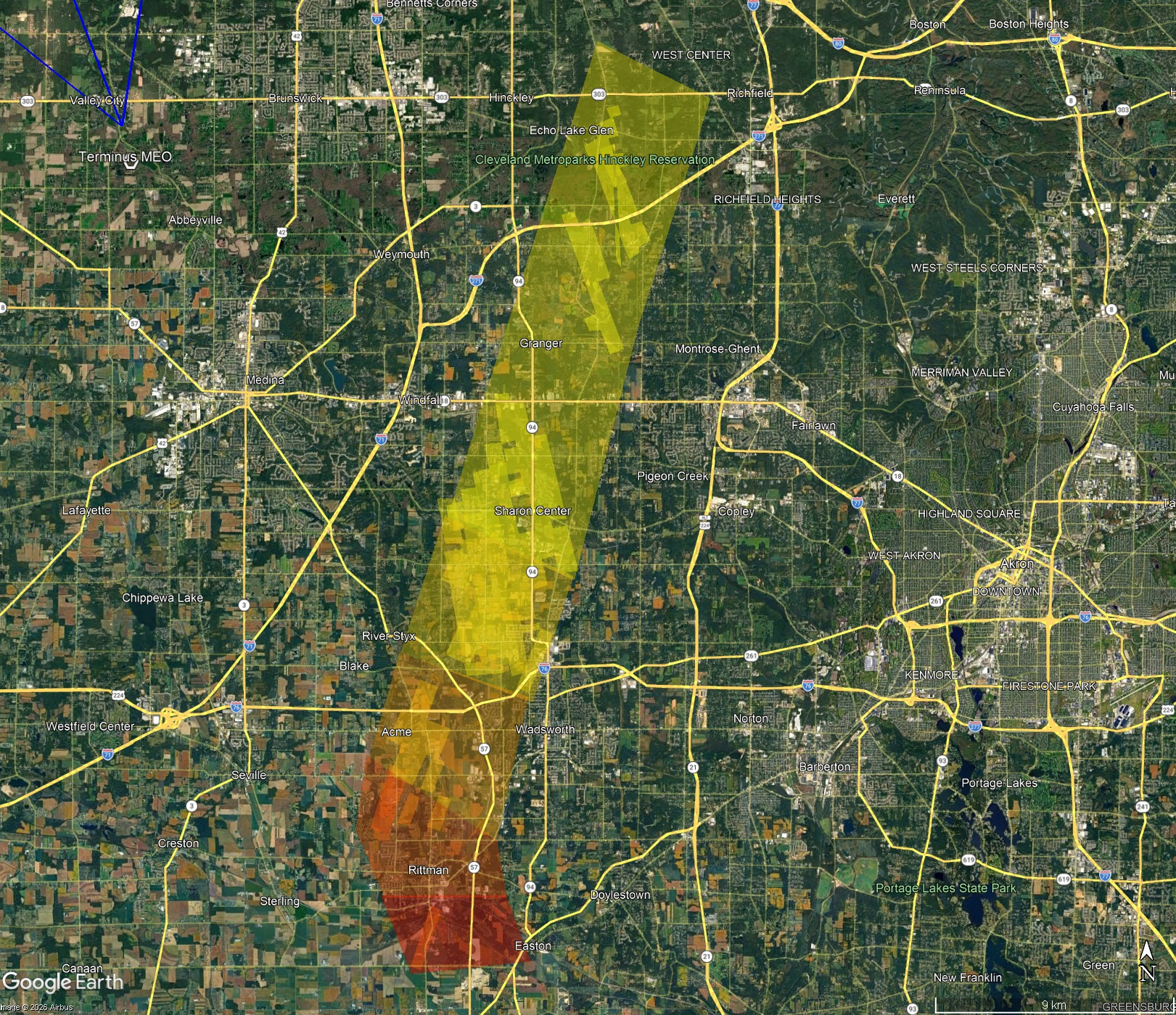
The meteorites would be found in an area not too far from Akron, spanning from Easton to Echo Lake Glen. The fields between Easton and Rittman are the general area that models suggest is the most likely to provide the largest meteorites. While radar signatures suggest that space rocks survived the explosive journey through the atmosphere, the model is based on potential sizes, and it doesn’t guarantee that such sizes actually formed in the explosion.
The asteroid moved through the atmosphere at 20 kilometers per second (45,000 mph), which is fast, but there have been faster space reentries. It was even spotted from space by the Geostationary Lightning Mapper on the GOES satellite, which reported its entry at about 80 kilometers (50 miles) of altitude. It traveled 54 kilometers (34 miles) in the atmosphere before falling apart 48 kilometers (30 miles) above Medina County.
How to look for meteorites
If you want to look for meteorites, there are a handful of suggestions on how to spot a real one. Of the many special properties of meteorites, density is an easy way to pick one out. They will be a lot heavier than your average rock due to them being made up of metallic iron and other dense materials. Metallic iron meteorites are often magnetic, so take a magnet for testing with you.
Their outside appearance is also peculiar due to their fusion crust, thanks to the dramatic experience of going through the Earth’s atmosphere at high speed. So they may look like a muddled lump of clay with odd thumbprint-like pits known as "regmaglypts" in.
Looking for meteorites in strewn fields is easier if the area does not have many rocks so that a dark or even blackened rock can stand out, like with the Winchcombe meteorite. We have more top tips here.
What to do if you find a meteorite
First of all, do not try to send them to NASA. It does not want them!
If a meteorite lands on your land, you own it. If it lands on federal lands, then it belongs to the government under the 1906 "Antiquities Act". If you find one on public lands, the Bureau of Land Management generally allows people to keep them. However, it's worth noting that it is generally prohibited to remove anything naturally occurring from National Parks. Find out more here.