Space and Physics
 PUBLISHED



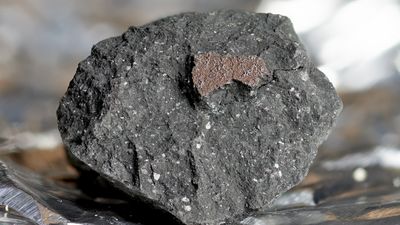


The evening of February 28, 2021, shouldn't have been anything special for the Wilcock family. It was the middle of the UK's third national lockdown during the COVID pandemic, and things were rather dull. But the heavens had other plans. A piece of space rock as old as our planet was about to plunge into the atmosphere and land over their town of Winchcombe.
It was 21:54 pm local time when the fireball was seen across the UK. The asteroid entered the atmosphere moving at 13.5 kilometers (8.4 miles) per second. People in the south of England reported the fireball, and cameras from meteor hunters and doorbells provided enough of a view to work out that if there were any fragments, they were falling over Gloucestershire.
At about 10 pm, a member of the Wilcock family reported hearing something outside. Planetary scientist Dr Helena Bates told me that they described it as “sounding like a photo frame falling off a wall”. They didn't know it yet, but they were the only person in the world who had heard the meteorite land.
That's because a fragment of it landed in the family driveway, where the Wilcocks saw it in the morning. They described it as if someone had thrown a piece of coal at the ground. It actually made a little dent in the driveway.
“They were having a discussion on their family WhatsApp group, 'What do you think this is?' And one of the (adult) children sent a link to the press release saying, ‘Hey, have you actually seen this? Like, I think this could be it. You're in the right area. It could well be that,'" Dr. Bates, who works at the Natural History Museum, told IFLScience. "And so the Wilcocks collected up the material. They scooped it into yogurt pots, plastic bags, sandwich bags, and stuff.”
The Wilcocks alerted scientists at the Natural History Museum, and their prompt action proved to be extremely beneficial. “One of the really unique things about Winchcombe was that it was collected very, very quickly,” Bates told me. It did not experience rainfall, and while contamination can happen pretty rapidly, the sample was as pristine as you could hope for after a meteorite fall. This allowed cutting-edge science, including the preservation of water-soluble material that might have been lost if the fragment had encountered rain.
As meteorites go, it isn't the most unique type, but it also isn't extremely common. It is a carbonaceous chondrite that represents 4.6 percent of all known meteorite falls. Still, its freshness allows research akin to that performed on sample-return missions like JAXA's Hayabusa2 and NASA's OSIRIS-REx.
“There was a special issue of a journal called Meteoritics and Planetary Science, which is a well-known journal in the planetary science and meteorites field,” Bates continued. “There were, I want to say, 15-odd papers within the special issue; individual analyses and research that was done by various groups around the world, and it's really impressive.”
From the intensity of the magnetic field during the formation of the Solar System, to the presence of important organic molecules, papers have revealed key insights about this primitive meteorite and where and when it came from.
Ultimately, though, it is the intersection of the celestial and the human that makes this finding really special. The scientific value is matched by the human effort to quickly preserve and share this find and its story. Even the landing site was saved when a 1 square metre (11 sq ft) area of the drive was collected on September 8, 2021.

Bates tells me, laughing: “It turns out, extracting a bloody driveway is not easy, because normally when you replace a driveway they just smash it up. Whereas with this one, we wanted to preserve that area!”
A local company came up with an ingenious way to preserve the segment and it is now displayed at the Natural History Museum in London, together with the largest piece of the meteorite, which was discovered in a field by Mira Ihasz, a volunteer with a search team from the University of Glasgow. Pieces of the meteorite are also now part of the collection at the Winchcombe Museum.
“It's this ancient ancient rock that comes from quite far out in our solar system that contains evidence of being exposed to water. And I think that's properly incredible. I think you can find out a lot about it from that,” Dr. Bates told IFLScience.
“But then also, I think one of the interesting things about Winchcombe is the whole story that came along with it. You know, it fell in this town in Gloucestershire, the family that found it, and the coming together of the planetary science community and the sort of effort, the love and the joy that we all had for it!”