Nature
 PUBLISHED
 9
9


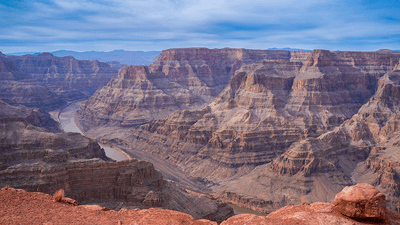


Geology is a complex topic, but if there's one simple principle you can generally rely on it is the law of superposition, or that the youngest strata (or layers of rock or sediment) will be above the older strata.
There are exceptions, of course – for example, faulting moving younger rock on top of older rock – but in general, the farther down you go, the older the rocks are. But sometimes as you go down through the layers of the rock, you find a break where layers of the geological record are missing, known as an unconformity.
"Unconformities are a type of geologic contact – a boundary between rocks – caused by a period of erosion or a pause in sediment accumulation, followed by the deposition of sediments anew," Jim Davis of the Utah Geological Survey explains. "Put simply, an unconformity is a break in time in an otherwise continuous rock record."
While unconformities are common, some of them take more explaining than others. In 1869, John Wesley Powell was studying layers of rock in the Grand Canyon when he noticed such an unconformity, finding 520-million-year-old rock sitting on top of rock between 1.4 and 1.8 billion years old.
"There's more than a billion years that's gone," Barra Peak, who led a previous study of the Great Unconformity explained in a statement in 2021. "It's also a billion years during an interesting part of Earth's history where the planet is transitioning from an older setting to the modern Earth we know today."
The Grand Canyon unconformity is an interesting find in itself, but it became a lot more intriguing when the Great Unconformity was found around the world.
"If you go to places on the Canadian Shield, you might see Archean, so 2.5-billion-year or older rocks, with sediments that are Cambrian or Ordovician on top of them," Brenhin Keller, assistant professor in Earth Sciences at Dartmouth College explained to PNAS on their Science Sessions podcast. "So you're missing 2 out of that 2.5 billion years. In other places, the gap may be much, much shorter, but in all cases, there's sort of an anomalous abundance of unconformities during this period."
There's no real consensus as to what caused the Great Unconformity, but there are hypotheses.
One proposed in 2019 suggested that the gap in the geological record the result of "snowball Earth", the hypothesis that during one or more times in Earth's history its surface almost entirely froze over. In this idea, the missing layers can be explained by glacier growth and then retraction, scouring at the rock and taking it into the seas.
Another idea is that it was caused by the formation of supercontinent Rodinia causing older rocks to be lifted up, where they were weathered and eroded away.
In a new study, a team of geologists studying ancient rocks at five sites in northern China believe that they have uncovered evidence that the events that caused the Great Unconformity took place hundreds of millions of years earlier than either hypothesis would expect.
The team reconstructed when the older rocks would have cooled as they rose towards the surface at these sites. They then analyzed radioactive elements within the rocks, allowing them to figure out how long it had been since the rocks cooled below a certain temperature.
"Dates from multichronometers and thermal history inversions show that the most substantial cooling of continental basement took place from ~2,100 to 1,600 [million years ago]," the team explains in their study.
That's far before Snowball Earth, thought to take place around 700 million years ago. According to the paper, there is another explanation: a different supercontinent.
"Comparison with thermal history data from Laurentia, Baltica, and Amazonia suggests that protracted plate tectonics broadly modulated by supercontinent cycles, and not 'snowball Earth' glaciation, is responsible for crustal exhumation below the unconformity," the team writes.
"The most pronounced erosion evident in both the thermochronologic record and geochemical indicators of continental weathering is shown to correspond with development of Earth’s first true supercontinent (Columbia), rather than with either the Cambrian explosion or the emergence of modern plate tectonics."
The new study is unlikely to end the debate, though it is certainly interesting, and likely to cause further debate amongst geologists on the topic, particularly given that the first animals appeared shortly after Snowball Earth.
The study is published in PNAS.