Nature
 PUBLISHED


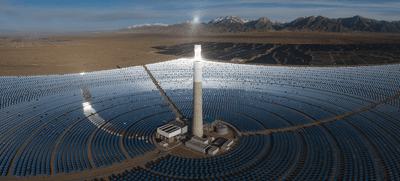


Solar panels are great at harnessing clean, renewable energy, but they have the major setback of relying on the Sun, which selfishly only shines for part of the day. In the deserts of China, though, a new solution has come to the fore: a silver sea of mirrors hooked up to a network of molten salt.
In the Gobi plains of Hami, Xinjiang Province, it's all systems go for a form of power plant that uses thousands of mirrors to collect sunlight during the day, then stores energy in molten salt to supply power at night.
China Three Gorges Corporation, which runs the hybrid plant, recently said it’s expected to generate about 2.067 billion kilowatt hours (kWh) of clean electricity annually and reduce carbon emissions by about 1.63 million tonnes.
As explained by PV Tech, the new breed of solar farm uses 260,000 mirrors to concentrate sunlight. Each of these panels can move independently to follow the Sun and catch as much light energy as possible
The energy is directed into absorber tubes that heat salt to 550°C (1,022°F), effectively turning it into a liquid battery that holds onto thermal energy. When power is needed after the Sun goes down, the molten salt can be used to drive a steam generation system, which powers conventional turbine generators to produce electricity.
“Capable of delivering stable power for up to eight hours straight, it serves as a core technology to guarantee non-stop grid reliability,” Niu Jianle, leader of the project, reportedly said.
“Lithium batteries are designed for short-duration peak shaving, while PV [photovoltaic] systems only produce power during daylight hours. [This] thermal storage stands apart with its large capacity, long discharge cycles and zero operational emissions,” the project director added.
China's renewable revolution
China's deserts are rapidly transforming into a "sea of silver” amid their slow but steady push towards renewable energy. It’s part of a massive initiative by the Chinese government to turn a huge strip of land – 400 kilometers (250 miles) long, 5 kilometers (3 miles) wide – into a "Great Wall" of solar panels.
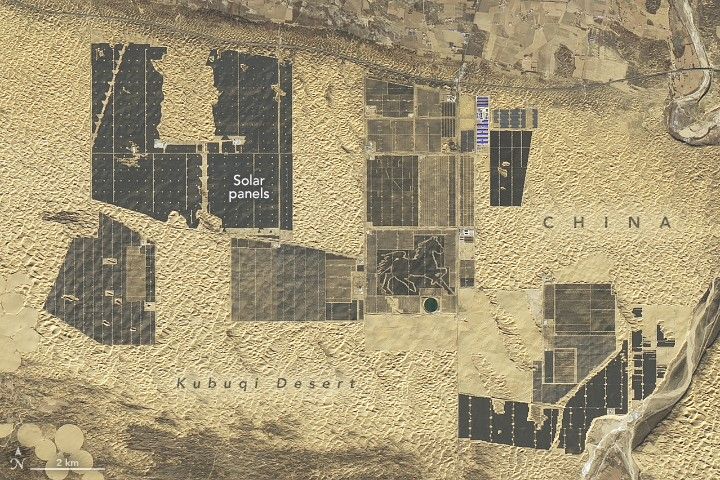
Much of the action is taking place in their northern province of Inner Mongolia, most of which is dominated by arid deserts. It’s not a continuous stretch of infrastructure, like China’s real “Great Wall” found slightly farther south, but a loosely knit cluster of solar power plants that hopes to take full advantage of the region’s relentless sunbeams.
Chinese state media has reported it aims to use this field of solar panels to transmit 48 billion kWh of green electricity annually to the Beijing-Tianjin-Hebei region via an ultra-high-voltage electricity transmission line by 2030.
There are also many solar power projects opening up in the neighbouring province of Xinjiang. This includes the largest solar farm in the world, the Xinjiang Solar Farm, covering 13,333 hectares (32,947 acres) and slated to produce about 6.09 billion kWh of electricity each year.
With all of this renewable infrastructure, it’s no surprise that China is the world's biggest solar power producer by a long shot, followed by the US, India, Japan, and Germany. Simultaneously, however, it is the largest producer of greenhouse gases by a considerable margin due to its heavy reliance on coal, oil, and gas.
China might be trailblazing on solar power, but it still has a long road ahead before it can shake its dependence on fossil fuels.

 1
1