Nature
 PUBLISHED
 5
5


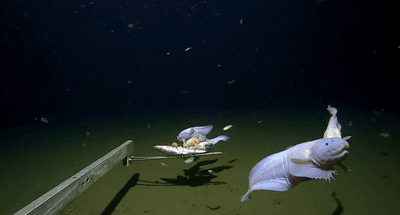


In 2023, scientists captured fish at depths exceeding 8 kilometers (4.8 miles) and recorded them even deeper. These findings not only set new records for deep-sea fish, but also suggest we may be nearing the maximum depths at which fish can exist.
At the western edge of the Pacific Ocean lies a series of trenches down to 11,000 meters (36,000 feet) deep, where the Pacific plate, typically 4,200 (13,780 feet) meters below the surface, sinks under various continental plates.
It was here, in the Izu-Ogasawara trench, that scientists filmed an unknown species of Pseudoliparis, a type of snailfish, at an incredible 8,336 meters (27,350 feet) down, breaking the previous record of deepest fish found at 8,178 meters (26,830 feet) in the famous Mariana trench.
The Mariana trench is the deepest known trench, and therefore the most studied, but it may not be the most interesting, biologically speaking.
“Everyone thinks that depth is the most important thing in these trenches,” Professor Alan Jamieson of the Minderoo-UWA Deep Sea Research Centre, who led the expedition, told IFLScience in 2023. Although depth, and the immense pressure it brings, does indeed shape life in these environments it's not the only factor. “Temperature can also be important,” Jamieson added.
The Izu-Ogasawara is the warmest of the trenches, and therefore more hospitable to life. Combined with the high productivity of the waters around Japan, which leads to more material sinking into this trench than the Mariana, conditions for life are far more appealing.
However, Jamieson explained to IFLScience, a team operating the research ship DSSV Pressure Drop reasoned that greater warmth in the Izu-Ogasawara would allow creatures to live at greater depths, so they decided to explore.
The team was proven right with the capture of Pseudoliparis belyaevi at 8,022 meters (26,319 feet) down, and film footage of the same genus but unknown species at 8,336meters (shown in the first 15 seconds of the video above).
“This disproves the claim we don't know anything about the deep sea,” Jamieson noted.
Jamieson explained that even though the waters above the Mariana are more tropical than the Izu-Ogasawara, the trench itself is colder because it is closer to the Southern Ocean. “Antarctica drives the whole thing,” he said.
Cold, salty water sinks to the bottom off the shores of the frozen continent, a process now being disrupted by global heating, and flows northwards, slowly warming up in its travels. Whenever this bottom water encounters a trench, it flows into it. By the time the water reaches the Izu-Ogasawara, it is less than a degree warmer than at the Mariana, but that is still enough to change the ecology.
“The Japanese trenches were incredible places to explore; they are so rich in life, even all the way at the bottom,” Jamieson said in a statement.
There are no warmer trenches of similar depth, so “If someone finds fish at greater depths, it won't be by much,” Jamieson told IFLScience.
The fact that snailfish have adapted to depths greater than any other vertebrate can survive is intriguing because they are not generally a deep-sea genus. Most snailfish live in shallow waters such as estuaries.
At these depths, the 20-25 centimeter (8-10 inch) fish are living on small crustaceans, which in turn feed on material that falls into the trench when surface water creatures die. “It can take weeks or months for this stuff to sink,” Jamieson said. Yet the hungry crustaceans see no use-by dates, and build a foodweb on whatever they can get.
An earlier version of this story was published in April 2023.