Nature
 PUBLISHED
 2
2


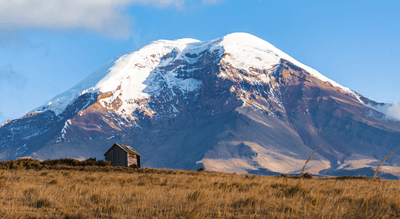


The summit of Mount Everest marks the highest point on planet Earth – or so you might think. While Everest is the undisputed king of altitude by many metrics, a humble contender in Ecuador actually sits closer to the stars and farther from Earth’s core.
Its name is Chimborazo, an inactive volcano in the Andes that stands 6,268 meters (20,564 feet) above sea level.
This is puny compared to other big dogs in the game: Everest at 8,849 meters (29,032 feet) above sea level and K2 at 8,611 meters (28,251 feet). In fact, Chimborazo isn’t even the tallest in this mountainous part of South America; it’s the 37th-tallest mountain in the Andes.
However, Chimborazo’s peak is technically closer to the Sun because of Earth's equatorial bulge. Our planet might look perfectly spherical marble from afar, but it’s actually an oblate spheroid, essentially a slightly squished ball. Because the Earth spins, centrifugal force causes it to "bulge" at the center, making the planet thicker around the equator than at the poles.
When we take this into account, Everest is at a disadvantage because it’s relatively far away from the equator, located along the border between Nepal and China at 28° North latitude. On the other hand, Chimborazo sits almost directly on the equator at just 1° South, very close to the “thickest” part of the globe. This also means that Chimborazo is the farthest point on Earth from the planet’s center.
Until the dawn of the 19th century, many suspected that Chimborazo was the tallest in the world. One of those was the esteemed German naturalist Alexander von Humboldt, who attempted to scale the Andean giant in the early 1800s. However, his ambitious adventure failed when he and his crew were overrun with nausea, nosebleeds, and other ailments of altitude sickness.
Scaling Chimborazo is still no walk in the park, although it’s far less punishing than Everest. Everest typically requires a 10-day trek to base camp, six weeks of acclimatization, and a grueling seven- to nine-day push to the summit. Meanwhile, Chimborazo can be conquered in about two weeks, with the final ascent taking only one or two days after the climber has adjusted to the air.
So if you ever reach Everest’s summit and feel the urge to shout, “I’m on top of the world!” – remember, you could’ve made that claim a whole lot more easily by heading to Ecuador instead.