Humans
 PUBLISHED



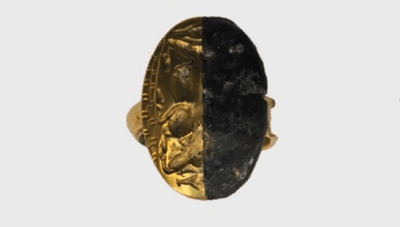


For a few hundred years in the ancient world, flashy rings made of space metal were all the rage among the elites of Mycenaean and Minoan society.
Flourishing during the Bronze Age, these two legendary civilizations predated the widespread adoption of iron smelting, and may therefore have valued meteoritic iron as a rare and highly valuable material.
Seen as the precursors to classical Ancient Greece, these two real-life polities were heavily mythologized by their successors, with the Mycenaeans acting as the main protagonists in Homer’s Odyssey and Iliad, while the Minoans - who lived on the island of Crete - were fictionalized as the keepers of the terrifying Minotaur.
In reality, these hugely significant groups formed part of an iconic age of Mediterranean Empires that also included the Ancient Egyptians.
The Pharaohs, it seems, were also fans of meteoritic iron, which was used to forge a dagger that was placed into the tomb of Tutankhamun. Elsewhere along the Nile, other ancient meteoritic artifacts have been interpreted as talismans that protected herds of camels from bad luck.
Fashion forward Greeks
Until now, however, no archaeological artifacts made from space rocks had ever been found in Greece. To figure out whether the Mycenaeans and Minoans used this extraterrestrial metal prior to the adoption of smelting, the authors of a new study analyzed the chemical composition of 91 Bronze-Age iron objects from across Crete and the Greek mainland.
In total, the researchers identified 13 objects containing high concentrations of nickel, hinting at a possible meteoritic origin. Upon closer examination, they conclude that nine of these are quite or very likely to have been forged from iron found in meteorites.
Significantly, all 13 of the items were large, ostentatious finger rings, such as bezel rings or signet rings. The majority were found in lavish burials and were mixed with gold, silver, or bronze, indicating that they were owned and worn by the palatial elites of Mycenaean and Minoan society.
According to the researchers, “the celestial nature of the meteoritic material might have made these rings a favourite choice for consumers craving for distinction,” which could explain their association with high-class individuals.
Sourcing meteorites in Ancient Greece
Meteorites, however, are very rare in Greece, largely because the country lacks desert environments where arid conditions can protect these space rocks from oxidation and disintegration. The authors therefore suggest that all of the rings were made from meteoritic iron that was imported from Egypt, which features large deserts and is therefore a fertile hunting ground for those seeking extraterrestrial rocks.
However, the space jewelry craze doesn’t seem to have lasted long, and these meteoritic rings apparently fell out of fashion after just a few centuries. From around 1300 BCE onwards, all of the artifacts analyzed by the researchers were found to be lacking in nickel, indicating that they were forged from iron that had been mined from the Earth.
This change coincides with the fall of the great Mycaenean and Minoan palaces, and may therefore represent a major social, political or economic upheaval in ancient Greece. Alternatively, the researchers suggest that “the meteoritic finger ring fashion, almost exclusive to Minoan and Mycenaean Late Bronze Age… “naturally” faded away as does any fashion.”
The study has been published in the Journal of Archaeological Science.