


 Humans
 PUBLISHED


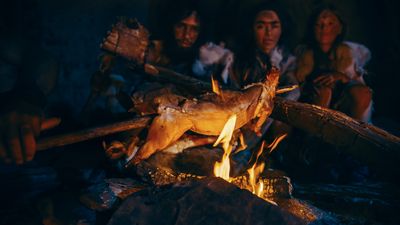


An ancient hominin that lived alongside modern humans in Asia may have been well adapted for hunting large game, but apparently wasn’t very good at fishing.
It’s unclear whether this aversion to seafood had anything to do with the extinction of this prehistoric species – known as the Denisovans – but these new dietary insights do at least give us a better picture of the ecological behavior of one of our closest evolutionary relatives.
Denisovans were a sister lineage to Neanderthals and occupied large swathes of Eurasia during the period in which Homo sapiens spread across the continent after leaving Africa. Yet while anthropologists have been studying Neanderthal fossils for almost 200 years, we only learnt of the existence of Denisovans in 2010, and are only just beginning to understand them.
Earlier this year, researchers analyzed a Denisovan shin bone that had been dredged up by fishers off the coast of Taiwan, revealing some intriguing details about the lives of these Pleistocene people.
For starters, radiocarbon dating indicated that the specimen – known as Penghu 3 – was 45,000 years old, proving that Denisovans were present in Taiwan at around the time when modern humans passed through southeast Asia on their way to Oceania.
Based on the length of the bone, researchers calculated that Penghu 3 was around 190 centimeters (over 6 feet 2 inches) tall, which is considerably taller than the average Homo sapiens or Neanderthal. The tibia also showed signs of healed injury, prompting the authors of a recent study – which is yet to be peer reviewed – to speculate that this individual may have got hurt while pursuing prey.
“These anatomical characteristics are consistent with a highly mobile lifestyle involving regular hunting, by utilizing their powerful physiques and high activity across open terrain,” write the researchers.
To back up this claim, the study authors conducted isotopic analyses on the Penghu 3 leg bone, indicating that the plants consumed by this Denisovan were typical of open environments like savannahs and flood plains. Nitrogen isotope levels, meanwhile, suggest that this ancient hominin consumed a lot of meat, and probably hunted megaherbivores.
Such a finding chimes well with other recent discoveries, including a cache of hunting weapons that were unearthed alongside Denisovan remains in a Chinese cave. Based on these stone tools, researchers have suggested that local Denisovans preyed upon the many large animals that they shared their environment with.
Surprisingly, however, the isotopic data points towards the fact that Penghu 3 did not dine on any of the aquatic foods offered by the nearby rivers and coastline.
“It is highly likely that a palaeo-river system existed in the Penghu Channel during the glacial period, when the area was connected to the mainland,” write the authors. “Despite this, no clear signals of aquatic resource consumption were found in Penghu 3.”
In contrast, modern humans in China and southeast Asia at this time exploited both terrestrial and aquatic environments, taking advantage of the full range of foods on offer in their environment.
“[T]his highlights remarkable differences in foraging flexibility between early-modern humans and the Denisovans in eastern Asia”, write the researchers.
Exactly how this fishless diet influenced the fate of the Denisovans is hard to say, and there are currently several theories regarding the cause of their extinction. However, based on this new evidence, the researchers say that competition with the Homo sapiens who entered their territory around 45,000 years ago might have contributed to the demise of this enigmatic hominin.
The study has been posted as an unreviewed preprint to bioRxiv.

 2
2