Humans
 PUBLISHED


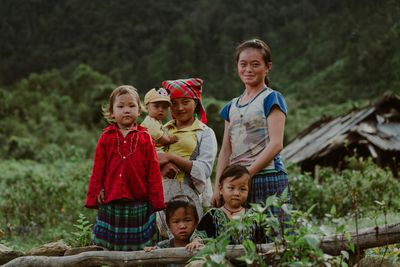


Prehistoric Homo sapiens seem to have had a real thing for Denisovans, and mated with this extinct human lineage pretty much everywhere they met. As a result, many present-day groups carry complex combinations of archaic genes, and new research shows that people in Southeast Asia possess DNA inherited from three distinct Denisovan populations.
The authors of the study, which has yet to undergo peer review, analyzed DNA from 14 different populations in mainland Southeast Asia as well as 16 Central Asian groups. They then compared these to the only fully sequenced Denisovan genome, which was obtained from the finger bone of a female individual known as Denisova 3, who lived in the famous Denisova Cave in the Altai Mountains of Siberia some time between 50,000 and 75,000 years ago.
“In Southeast Asian genomes, we see that there is a cluster of [Denisovan] segments that are very similar to the genome of Denisova 3, another that is moderately similar, and finally one that is very distinct,” study author Charlotte Antoine-Derouet told IFLScience. These three clusters must therefore have been inherited from three separate Denisovan populations, with varying degrees of genetic closeness to Denisova 3.
We don't know exactly where it all happened, but thanks to this study we are more sure that Denisovans were not only present in the Altai Mountains.
Charlotte Antoine-Derouet
Among Central Asian genomes, the team only noted two distinct Denisovan clusters. And while most people across Asia possess less than 1 percent Denisovan DNA overall, the study authors were able to identify a few Denisovan genes that appear to have been retained through positive selection over thousands of years – including some that are involved in immune function and one that influences hair shape.
Exactly where or when our ancestors interbred with these Denisovan groups is impossible to say, although it’s likely that at least one admixture event occurred close to the Denisova Cave itself.
“Because one cluster is very close to Denisova 3, we think that this is potentially a population that lived close to the Altai Mountains,” said Antoine-Derouet. “So my hypothesis is that this admixture happened in the north or northeast, and then during the Neolithic expansion, when Chinese farmers came to the south, they brought this Denisovan ancestry with them and mixed with local hunter-gatherers in southeast Asia.”
“And I think that this is how Southeast Asia inherited this first admixture that’s very close to Denisova 3,” she explained.
However, because no Denisovan genomes from Southeast Asia have ever been sequenced, it’s very difficult to speculate as to where the other two interbreeding events might have occurred. What we do know, however, is that modern-day populations in Papua New Guinea and the Philippines also carry Denisovan DNA, and that at least some of this does not match the Denisovan clusters found in mainland Southeast Asian genomes.
“So one hypothesis is that the admixture process happened in the islands, and then people came back to the mainland and interbred with local populations there,” said Antoine-Derouet. “But admixture events might also have happened in mainland Southeast Asia,” she added.
Despite these lingering question marks, the results of this study do at least confirm that Denisovans were widespread across Asia and that they repeatedly interacted with numerous Homo sapiens groups. “We don't know exactly where it all happened, but thanks to this study we are more sure that Denisovans were not only present in the Altai Mountains,” concluded Antoine-Derouet.
A preprint of the study is currently available on bioRxiv.