Humans
 PUBLISHED


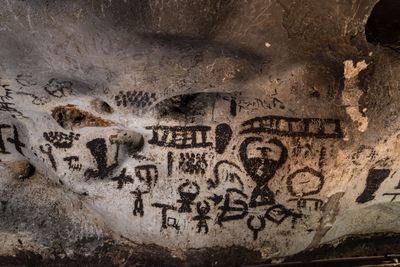


The dynamic, colorful portraits of wild beasts are typically the show-stealers in prehistoric caves, but look closer and there's something much subtler, much stranger going on: 32 symbols, repeated time and time again across Europe and beyond.
The recurring prehistoric symbols have become a central theme in the work of palaeoanthropologist Genevieve von Petzinger. An account of the research can be found in her book, The First Signs: Unlocking the Mysteries of the World's Oldest Symbols, published in 2016.
The project began in 2007, when von Petzinger set out to document all of the geometric signs found across Europe's 350+ prehistoric cave sites, drawing on existing records as well as her own fieldwork in Spain, France, and Sicily.
All in all, she identified just 32 abstract symbols that appeared repeatedly across Europe between 40,000 years ago and 10,000 years ago, just after the end of the last Ice Age.
These shapes included things like simple lines, triangles, spirals, Y-signs, zigzags, circles, crosses, asterisks, as well as slightly more complicated symbols like crosshatches, hand shapes, and feathers.
Despite being scribbled thousands upon thousands of times, often thousands of kilometers apart, there was a remarkable consistency in the symbols and the style in which they were scrawled.
“If these were random doodles or decorations, we would expect to see a lot more variation, but instead what we find are the same signs, repeating across both space and time,” von Petzinger explained at her TED Talk in 2015.
“Some signs start out strong, before losing popularity and vanishing, while other signs are later inventions. But 65 percent of those signs stayed in use during that entire [30,000-year] time period,” she added.
Beyond Europe, some of these signs have also been seen in cave walls across every continent, bar Antarctica. This has left her to wonder whether these symbols have a deeper, common point of origin in Africa, where Homo sapiens first emerged.
But what could it all mean? Without an interview with a troglodyte from 40,000 years ago, it’s almost impossible to know. However, von Petzinger does believe they were a form of communication, perhaps to mark ownership of a cave or tell others “I was here, this is who I am."
If that view is accurate, it would make these 32 symbols one of the oldest systems of written communication in the world and may point towards the origin of written language.
“There can be no doubt that these signs were meaningful to their creators. We might not know what they meant, but the people of that time certainly did. The repetition of the same signs for so long and at so many sites tells us that the artists were making intentional choices,” she told NPR in 2022.
“If we're talking about geometric shapes with specific, culturally recognized, agreed upon meanings, then we could very well be looking at one of the oldest systems of communication in the world.”