Humans
 PUBLISHED



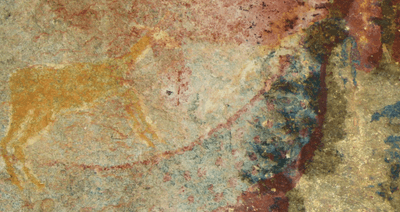


On the rock walls of South Africa's Karoo Basin, an unusual tusked beast is painted alongside scenes of human warriors.
Many who encountered the image assumed it was just another animal from the local landscape, but a provocative 2024 study published in PLOS One argued it represents something far more remarkable: a creature that went extinct 200 million years ago and whose fossils can be found scattered across this part of Africa.
The researcher behind this idea then went even further, suggesting it may indicate the San people of South Africa were practicing something akin to "Indigenous palaeontology".
“Many cultures explored the world of fossils before Western scientists did,” Julien Benoit, author of the 2024 study from the Evolutionary Studies Institute at the University of the Witwatersrand, said in an interview with IFLScience when the paper was released.
Benoit's research centers on a painting created by the San people in the Karoo, southern South Africa, sometime between 1821 and 1835, known as the "Horned Serpent panel." Alongside illustrations of human warriors holding shields, the mural depicts a long-bodied animal with downward-turned tusks that doesn't match any creature living in the region today.
At a glance, it could pass for a walrus. Except these tusky animals live near the North Pole, in the opposite hemisphere. You might instead chalk it up to the San's "spirit world," but their artworks are almost always rooted in something real, directly drawn from the physical world.
So could it depict an extinct animal instead? It's a possibility Benoit thinks is worth taking seriously.
Archaeological evidence suggests the San people found and transported fossils across long distances over land. Some researchers have even proposed that they depicted dinosaurs in their rock art, likely drawing inspiration from fossils and footprints found in the region.
Benoit also points to several San myths describing large animals that vanished long ago. The study cites an account from 1905 describing how the San would speak of their ancestors encountering "great monstrous brutes, exceeding the elephant or hippopotamus in bulk."
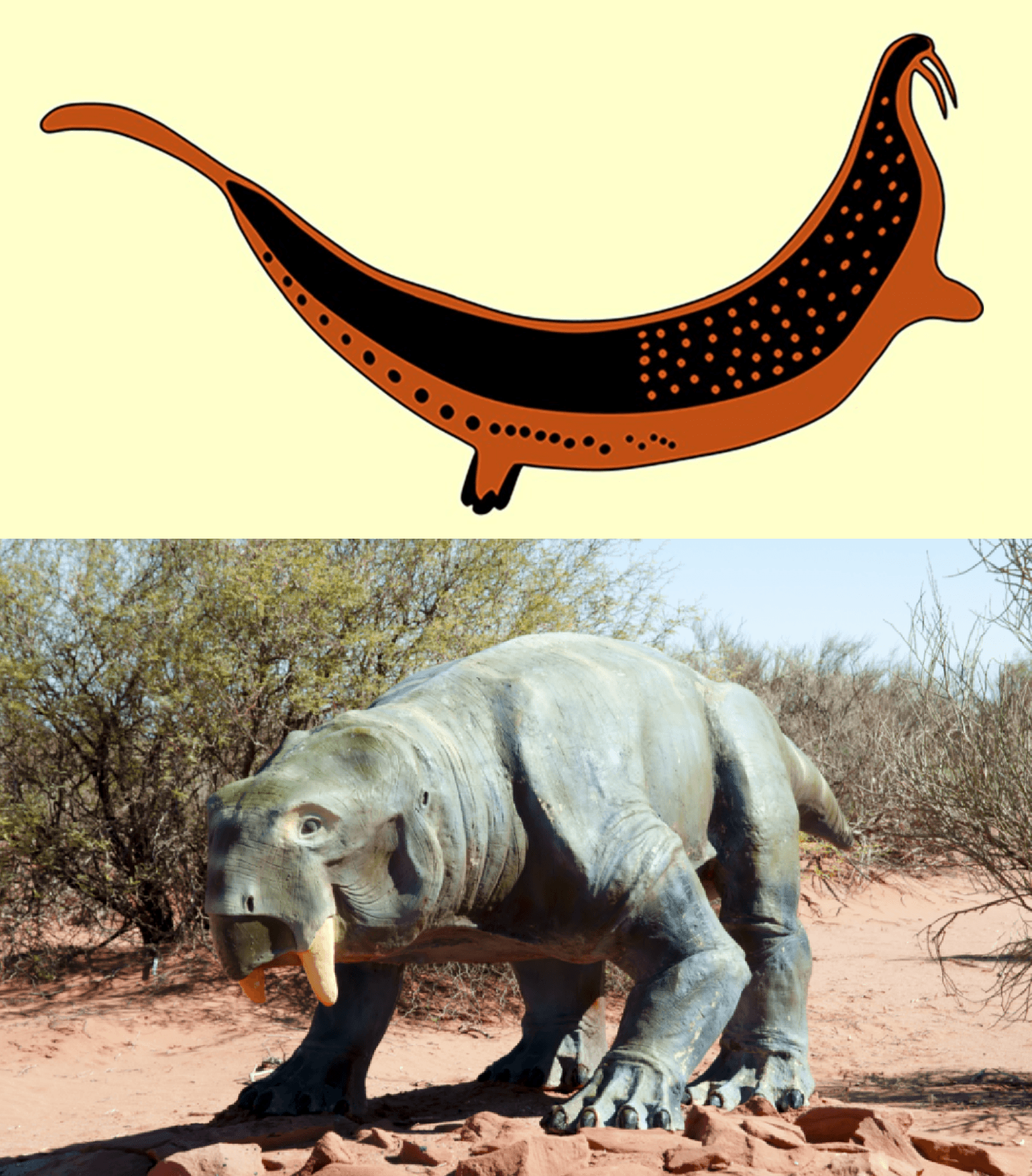
One fitting culprit for these myths might be dicynodonts. These were strange ancestors of mammals that sported two large, downward-pointing tusks and likely resembled a prehistoric cross between a hippo and a giant lizard.
Dicynodonts lived around 200 million years ago, but their fossil remains, including skulls, can be found throughout much of the Karoo where the San people lived. Taken together, these threads of evidence could suggest that the San people were aware of these extinct animals that predated their own, and then weaved that awareness into their spiritual beliefs.
It's no coincidence, Benoit argues, that San spiritual tradition includes a recurring "rain-animal" figure characterized by tusks. Perhaps, he ponders, the sight of a fossil helped to somehow inspire this myth.
“Of course, at this point it is speculative, but the tusked animal on the Horned Serpent panel was likely painted as a rain-animal, which means it was probably involved [in] rain-making ceremonies,” Benoit told IFLScience.
“During rain-making ceremonies, the San enter a state of trance and enter the realm of the dead to catch rain-animals and bring the rain back to the world of the living. By picking a species such as a dicynodont, that they knew was extinct and thus dead, they likely hoped this rain-animal had some increased potency to bridge the two worlds,” he added.
Some will undoubtedly think this is a bit of a leap. Instead of jumping to fossils and extinct creatures, why not conclude that the rock art depicts something more grounded, like a seal or a hippopotamus?
Be that as it may, many different instances have shown that Indigenous knowledge has a lot more depth and validity than it’s often given credit for, especially in the fields of astronomy, biology, and ecology. Perhaps palaeontology is no different.
An earlier version of this article was published in September 2024.

 2
2