Humans
 PUBLISHED



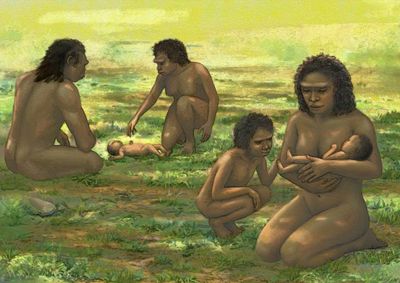


Unlike the other great apes, humans give birth to helpless infants that can’t even lift their heads, let alone walk. It isn't clear whether all hominins were like this, but new research suggests at least Homo erectus and Homo floresiensis – commonly known as the Hobbits – also had hapless babies.
The reason for our incompetence as infants stems from our upright posture, which constricts the width of the birth canal. To fit through, we have to be born while our brains are still small and undeveloped, before spending our entire childhood getting up to speed.
We also start out with soft skulls and weak neck muscles. As a consequence, newborns are prone to spending long periods of time lying on their backs without moving, which can result in the rear of the skull becoming squished. This condition is known as deformational plagiocephaly, or flat head syndrome.
To figure out if archaic humans displayed a similar development pattern, researchers compared the skulls of 123 modern, healthy babies and toddlers with those of 385 historical Homo sapiens and 996 non-hominin great apes. Crucially, they also assessed six fossilized Homo erectus skulls and one belonging to Homo floresiensis.
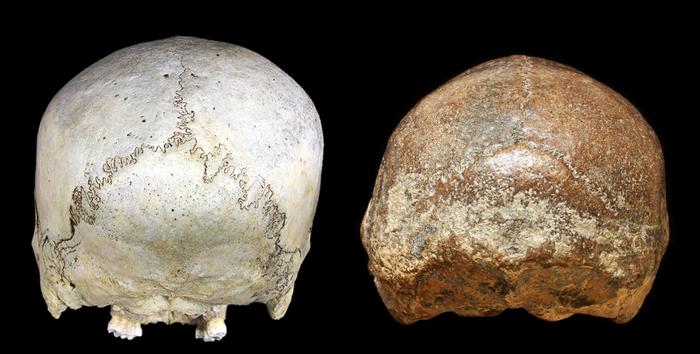
Overall, the non-hominin great apes displayed a much narrower range of cranial deformation than the human specimens, reflecting the fact that newborn chimps, gorillas, orangutans, and bonobos are much more mobile than human infants.
Interestingly, though, two of the H. erectus fossils and the Hobbit skull showed a level of deformation that appears consistent with flat head syndrome.
“The three archaic Homo individuals most likely experienced marked deformational plagiocephaly under a human-like infant growth pattern, and a human-like habit of sleeping on the ground,” write the study authors.
Such a finding implies that these prehistoric human species gave birth to helpless babies and so may have had to develop sophisticated parenting strategies in order to care for their young until they could look after themselves.
In particular, these prehistoric parents might have had to keep their babies safe from dangerous predators, say the researchers. For instance, they explain that “these archaic Homo taxa successfully protected and nurtured their feeble babies in the presence of tigers and leopards (H. erectus) or Komodo monitors and giant carrion birds (H. floresiensis).”
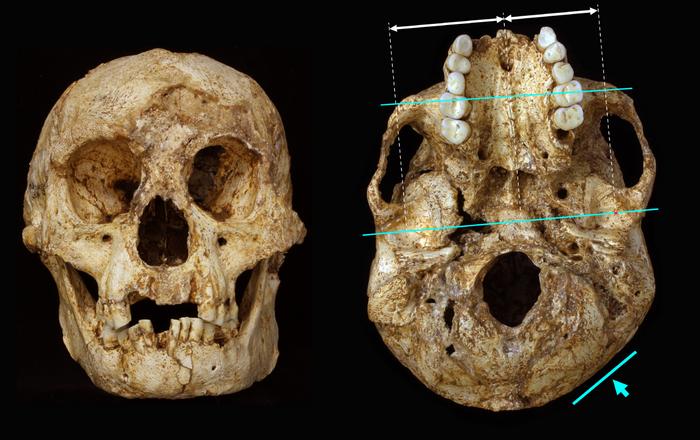
It's worth pointing out that only six archaic fossils were included in this study, all of which belonged to adult individuals found in Indonesia. It's therefore unclear if similar patterns of cranial deformation appear in the wider fossil record.
However, based on finding only two skulls among 996 non-hominin great apes with similar levels of flattening, the researchers calculate that – were Homo erectus not prone to flat head syndrome – the probability of randomly selecting two Homo erectus skulls displaying these kinds of dents would be around 0.004 percent.
They also argue that the deformations seen in these specimens are unlikely to have been caused by factors such as crushing after death, so they were probably present since infancy.
“If they gave birth to physically helpless babies, then this tells us something about their behaviors, as they would need to have cared for the baby as diligently as we do,” said study author Yousuke Kaifu in a statement.
“This likely would have necessitated some social interactions, as it would be difficult for the mother to care for and protect the newborn in that environment, where there would have been other large predators, on her own,” he said.
That such advanced behaviors might have existed in the Hobbit humans is particularly surprising, given that this extinct species had a brain that was roughly the same size as a chimpanzee’s. And, admittedly, the evidence in this case is less strong, since the researchers only had one skull to work with.
Commenting on this finding, Kaifu suggests that “rather than just being a trade-off for our large brains, the challenging responsibility of childcare and supporting mothers with their infants may actually be an integral part of our human history, at least since the time of the common ancestor of Homo erectus and Homo floresiensis more than one million years ago.”
The study has been published in the Proceedings of the Royal Society B Biological Sciences.


 6
6