Humans
 PUBLISHED
 1
1


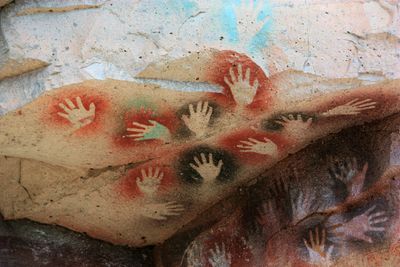


Hand stencils are among the oldest and most widespread forms of prehistoric rock art, appearing at ancient sites across the globe. Some of these handprints, however, stand out more than others due to their unusual decorations, and new research is beginning to shed light on the ancient beliefs associated with these snazzy artworks.
Humans have been leaving colorful imprints of their hands on walls for pretty much forever. In fact, the world’s earliest known rock art consists of a bunch of hand stencils in Indonesia. Previous research has shown that it was often children that produced these playful murals, although it seems likely that some hand motifs were also the work of community leaders, possibly for ritual purposes.
In the Colombian Amazon, for example, lies the Serranía de la Lindosa outcrop, which is decorated with thousands of illustrations dating back some 11,000 years. Perhaps the world’s most spectacular rock art assemblage, this gigantic painted landscape has previously been linked to shamanic practices.
Through interviews with Indigenous tribal elders, anthropologists learned that many of the motifs present at La Lindosa represent shamanic transformations, whereby prehistoric leaders are depicted entering a spiritual dimension and taking the form of powerful animals like jaguars or snakes.
In a new study, researchers turn their attention to the unusual decorated handprints found at two of the main rockfaces within the Serranía de la Lindosa.
Known as Cerro Azul and Paredones del Potrero, these two painted sites contain a combined total of 496 handprints, of which 348 (70 percent) are decorated with eye-catching designs across the palm and fingers. For instance, 256 examples of these hand stencils contain spiral patterns, while linear motifs – including zigzags and ellipses – appear on 84 of the prints.
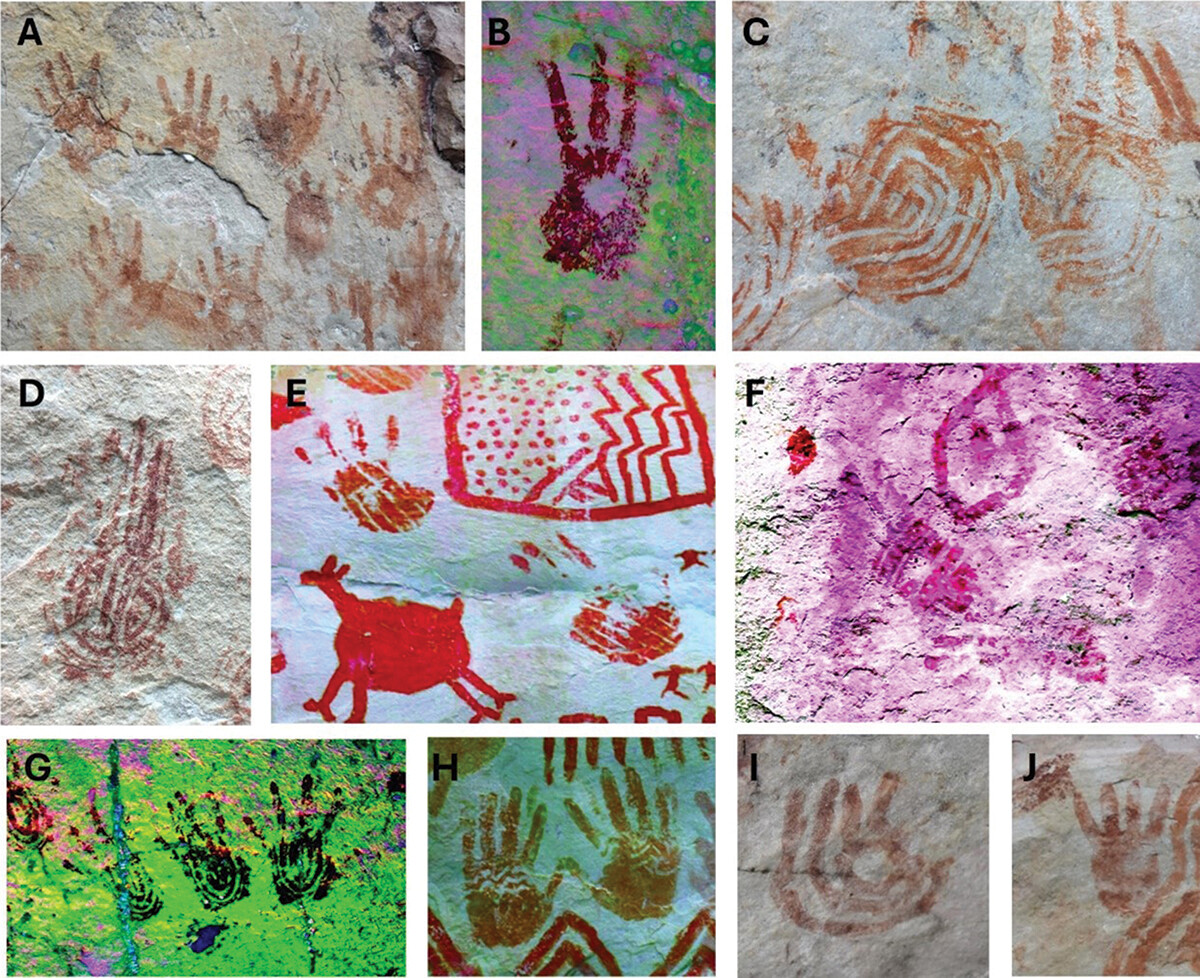
Interestingly, the majority of these hand motifs were found at heights of between 2 and 3 meters (6.5 to 9.8 feet) above the ground, suggesting they were created with the aid of a ladder or scaffolding, and hinting at their importance.
To understand what all this might mean, researchers once again turned to local Indigenous elders, who were able to shed some light on the purpose of these mysterious ancient designs.
“According to Ulderico Matapí, a ritual specialist of the Matapí group, each hand motif represents a form of shamanic knowledge – such as the ability to cultivate land or collect medicinal plants – critical for managing territory,” write the study authors.
“Similarly, Desana elder Victor Caycedo interprets stylistic differences between hand types as signalling the presence of different ‘tribes’, each asserting spiritual or social identity,” they continue.
Overall, these interviews pointed towards the idea that the hand prints “encoded cosmological principles and ritual authority,” and that rock art traditions reflected an ancient belief system “in which rock walls are seen as liminal zones where human, ancestral and spirit realms meet.”
Ultimately, the researchers stop short of attaching concrete meanings to individual designs or motifs. However, their work does serve to highlight the importance of collaborating with local Indigenous communities when studying prehistoric rock art.
The study is published in the journal World Archaeology.