Humans
 PUBLISHED
 2
2




Parts of the "Treasure of Villena" found in the Iberian Peninsula appear to have originated from space, new research has revealed.
First discovered in 1963, the Treasure of Villena is a haul of 66 items largely made of gold and silver. The treasure – including bracelets, bowls, bottles, and other ornaments – was a significant find, dating back to the European Bronze Age, and representing one of the most important examples of goldsmithing from the area and time.
But dating the treasure precisely has been somewhat troublesome, due to the presence of one metal.
"The discovery of the Cabezo Redondo Treasure (Villena, Alicante), also in 1963, with some golden pieces related to those of Villena, suggest dates for both groups within the Late Bronze Age (1400-1200 cal BC)," the team explains in their study.
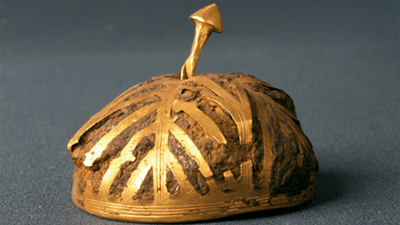
"The bone of contention that forced some researchers to lower the chronology well into the Late Bronze Age is the existence in the Villena Treasure of two iron metal pieces: a small hollow semisphere covered with an openwork sheet of gold, supposedly interpreted as the end of a sceptre or baton of command or as a sword hilt, and an open bracelet."

These items are confusing precisely because they are made of iron, which doesn't fit well as the Iron Age began later, in the ninth century BCE. This led some archaeologists to date the treasure to this later period.
However, there is another possibility; that the iron within the items came from meteorites, rather than terrestrial sources. Other items from the ancient past, including Tutankhamun’s dagger, have been found to have been made from iron delivered to the Earth via meteorite.
While invasive techniques of determining if the metal was meteoric were ruled out, the team was able to analyze samples using mass spectrometry.
"The results of the analyses carried out on the iron pieces from the Villena Treasure presented here indicate with great probability that they are objects made of meteoritic iron," the team explained. "The cap was possibly made of meteoritic iron, with a nickel content of 5.5%, [comparable to] the global composition of the Mundrabilla meteorite (Australia) analyzed years before in the Freiburg laboratory."
The bracelet initially looked to contain less nickel at around 2.8 percent, though follow-up tests showed slightly higher nickel content. Further analysis of samples, potentially from deeper into the artifacts, or more expensive tests would be needed to say for certain that the metal came from an extraterrestrial source. However, looking at the archaeological and historical context alongside the chemical analysis, it looks likely that the metal came from a meteorite.
"The available data indicate that the helmet and bracelet from the Villena Treasure would be the first two pieces attributable to meteoritic iron in the Iberian Peninsula, which is compatible with a Late Bronze Age chronology, prior to the start of widespread terrestrial iron production," the team wrote in their conclusion. "The chronology of the abandonment of Cabezo Redondo is placed at a time before 1200 cal BC[E]."
The study is published in Trabajos de Prehistoria.