Humans
 PUBLISHED
 3
3


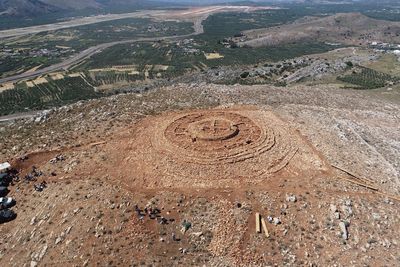


In Greek mythology, the island of Crete provides the setting for a legendary battle between the heroic Theseus and the half-human, half-bull monstrosity known as the Minotaur, which is said to have lived inside a maddening labyrinth. And while there’s little truth to this fable, archaeologists have just discovered a monumental labyrinthine structure atop a Cretan hill.
According to a statement from the Greek Ministry of Culture, the unusual construction is the first of its kind to be discovered in Crete and was likely built by the Minoans between 2000 and 1700 BCE. Often regarded as the first true civilization in Europe, the Bronze Age Minoan culture is famed for its monumental palaces and innovative writing system.
The newly discovered labyrinth is located at an altitude of 494 meters (1,621 feet), at the summit of Papoura Hill, and was found during the installation of a radar system for a new airport servicing the town of Kastelli. Officials have announced that the construction of the airport will still go ahead, but that a new location will be found for the radar equipment so that the ancient site can be excavated and protected.
Consisting of eight concentric circular walls – with an average thickness of 1.4 meters (4.6 feet) – the unusual structure measures 48 meters (157 feet) across and covers a total of 1,800 square meters (19,375 square feet), with the maximum height of the surviving walls estimated at 1.7 meters (5.6 feet). The labyrinth is divided into four zones by a series of radial walls that intersect the various rings, while small openings act as passageways between these sections.
At the center of the labyrinth is a circular building, which is also divided into four quadrants. According to the Ministry of Culture, the full layout and total height of the confusing structure remain unknown, but will hopefully be revealed as excavation work continues.

In all likelihood, the site was built around the time that the very first Minoan palaces were erected. Based on the distribution of animal bones within the inner rings of the maze, experts believe it probably served as a ceremonial space where rituals involving offerings and feasts were conducted.
Despite the temptation to draw parallels between this stunning discovery and the mythological lair of the Minotaur, it’s highly unlikely that the two are connected. For one thing, the hideous bull-man creature is said to have lived in an underground labyrinth in the ancient town of Knossos, so the locations don’t match.
So far, no evidence that the Minotaur or his subterranean hellhole existed has ever been discovered – and it probably never will. Still, the appearance of a labyrinth on the island of Crete is sure to excite mythology lovers.