Humans
 PUBLISHED

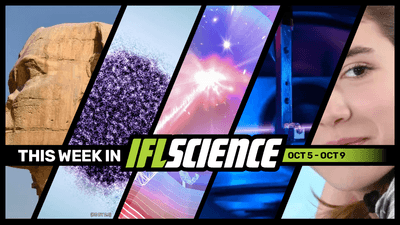


This week, new research finds just five viral and bacterial infections were behind almost all infection-linked cancers, the first-ever thorium-based nuclear atomic clock could be a revolutionary tool in probing fundamental physics, and science suggests a key vocal feature could influence who likes us. Finally, we spoke to Josh Davis, IFLScience editor and writer and author of A Little Gay Natural History, to learn more about just how queer the natural world really is.
Create an IFLScience account to get all the biggest science news delivered straight to your inbox every Wednesday and Saturday.
Skull Of An Extinct Crocodile Found In The Rocks Used To Build The Sphinx And The Pyramids Turns Out To Be A New Species
Tens of millions of years before the Ancient Egyptians erected their iconic monuments, the quarry from which they extracted their building materials was home to a crocodylian thought to be related to a living species of gavial. Read the full story here
Infectious Diseases Caused 2 Million Cancer Cases In 2024 – That's 1 In 8 Of All New Diagnoses Worldwide
There's a lot of advice out there about reducing your cancer risk. Avoid smoking, limit your alcohol consumption, prioritize eating whole foods, and get regular exercise – these are all mainstays of the cancer prevention toolkit. We tend to see the concepts of cancer and infections diseases as separate things, but there’s a lot more crossover than you might expect. Read the full story here
Most Distant Fast Radio Burst Yet Discovered – It Traveled For More Than 10 Billion Years To Reach Us
Fast radio bursts are nothing short of prodigious. In a fraction of a second, they pack the energy that our Sun would produce over several days. These powerful emissions of radio waves come to us from the distant universe, but none as far as the newly detected FRB 20240304B. Read the full story here
First-Ever Thorium-Based Nuclear Atomic Clock Is A New Tool To Probe Fundamental Forces – And Even Hunt For Dark Matter
The world of precision timekeeping has a new kid on the block. Researchers have presented the first functioning thorium-229 nuclear clock. The breakthrough has so many exciting possibilities, from higher-precision timekeeping to a new way to probe what we know and don’t know about the universe. Read the full story here
Want To Know If Someone Likes You? Science Suggests A Key Vocal Feature Can Reveal Who We Like, And Influence Who Likes Us
There’s a reason flirting is so often referred to as an art. The rules are vague, the approaches varied, and the beauty of it ultimately depends on the beholder. That said, science has been able to identify behavioral patterns that – as a general rule – can be seen as indicators of attraction. Some of them can even be heard. Read the full story here
TWIS is published weekly on our Linkedin page, join us there for even more content.
Feature of the week:
How Queer Is The Animal World? We Haven't Looked As Hard As We Could, But Nature Is Still More Diverse Than You Think
IFLScience is no stranger to stories about animal behaviors; ranging from the cute and cuddly to the plain unusual, planet Earth has just about every behavior you can think of. And that includes an astonishing diversity of sexual behaviour, biology and reproductive strategies. Read the full story here
More content:
Cover Story: Dreams are utterly bonkers at the best of times, yet when we’re feeling a little off-color we can get a glimpse of how deep the rabbit hole really goes. In this exclusive CURIOUS Magazine cover story, we explore the science of fever dreams.
To access exclusive CURIOUS content first and receive the quarterly digital magazine, become an All Access Member.
PLUS, the We Have Questions podcast – an audio version of our coveted CURIOUS e-magazine column – continues. In episode 25, we ask, “Why Do Hammerhead Sharks Have Hammer-Shaped Heads?”
The Big Questions podcast continues as we ask, “Are Artificial Intelligence Chatbots Safe?” Host Rachael Funnell speaks to Professor Hannah Fry, presenter of the BBC series AI Confidential, to find out how AI chatbots can and have become a part of people’s lives, and what can happen when such a relationship takes a turn.