Humans
 PUBLISHED
 3
3




Everyone, it seems, has a hot take on Christopher Nolan's multi-million-dollar interpretation of The Odyssey, but beyond the glowing reviews/snooty commentaries and engagement farmers on social media, what do historians make of the movie? How much of it is historical fact, and how much is Hollywood codswallop?
To find out, IFLScience asked Dr Josho Brouwers, Dr Matthew Lloyd, and Dr Owen Rees of Bad Ancient, a ragtag team of historians and archaeologists who debunk misinformation and misconceptions about the ancient world, what they thought.
We previously spoke to them about Gladiator II, so this time we wanted their take on The Odyssey. We were especially keen to get their thoughts on the mysterious so-called "Sea Peoples", who are painted in the movie as an encroaching threat to the existing civilizations lurking somewhere over the waves (and perhaps within ourselves).
Who were the supposed Sea Peoples?
To armchair archaeologists, the Sea Peoples are associated with the late 13th to early 12th century BCE, a period when a string of great civilizations across the Eastern Mediterranean seemingly crumbled into ruin during the Late Bronze Age Collapse.
Some historians like to pin the upheaval to the year 1177 BCE, but it's best imagined as a complex cascade of events that rumbled through the region over several decades. Rome didn't fall in a day, as they say.
The most prominent victims were the Hittite Empire, Mycenaean Greece, and Levantine city-states like Canaan, but the shockwaves were felt by many other highly organized cultures that managed to survive, including the Egyptian New Kingdom and the Middle Assyrian Empire in Mesopotamia.
Over the past few centuries, the Sea Peoples were often singled out as the prime culprit behind this upset. They were painted as an unidentified group of men who sailed up to these coastlines, raided their stocks, and razed their cities. Some might have stayed in the conquered lands, while others might have swiftly left, but either way, each place was never the same after their unwelcome visit.
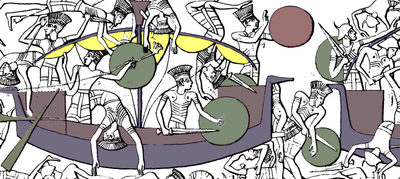
Some of the most convincing evidence of seafaring invaders around this time comes from a handful of ancient sources, primarily from Egypt, which managed to claw on through the late Bronze Age collapse and tell their story.
“The main sources are Egyptian, dating from the late New Kingdom. Large, monumental inscriptions of at least two Pharaohs – Merneptah and Rameses III – describe victories against a possible coalition of enemies, some of whom came from across the sea. The most famous of these inscriptions are the ones that record Rameses III’s victory in about 1175 BCE,” the Bad Ancient team told IFLScience.
Were the Sea Peoples real?
However, the ancient Egyptians would not have referred to these invading marauders as “Sea Peoples,” nor would any ancient culture at the time (just like the ancient Greeks would not have referred to themselves as Greek). The term does not appear in Homer's original text at all, and you won't find them namechecked in any legitimate version that's been translated since.
The evidence used to build this idea of the so-called ‘Sea Peoples’ makes clear that they were not a unified single group or culture.
Bad Ancient
Instead, this term was an artificial construct, coined by historians in the 19th century who were left to piece together the demise of Bronze Age civilizations in the eastern Mediterranean with scant evidence.
“The evidence used to build this idea of the so-called ‘Sea Peoples’ makes clear that they were not a unified single group or culture," explained the Bad Ancient team.
"Egyptologists have identified at least 10 different groups that are lumped together under the term ‘Sea Peoples’, but there is much debate as to where these different groups actually came from.”
The idea that a foreign invasion replaced the great people of the Eastern Mediterranean also fed neatly into the deeply dubious idea that the ancient Greeks, like the Dorians, who built great cities and sparked Western philosophy, were somehow racially distinct from, and unrelated to, the Greeks of today.
“Archaeologists of the early 20th century thought simple invasion narratives were enough to explain change in material culture, the physical remains of the past," they added.
"The concept became ingrained in various racial theories of the 1930s: imagining that the Dorians came from north-central Europe rather than northern Greece, and that ancient Greeks were racially distinct from 20th-century Greeks, imagined as blond-haired and blue-eyed Aryans, played well into contemporary racism, but has zero basis in ancient evidence.”
What does the archaeological record tell us?
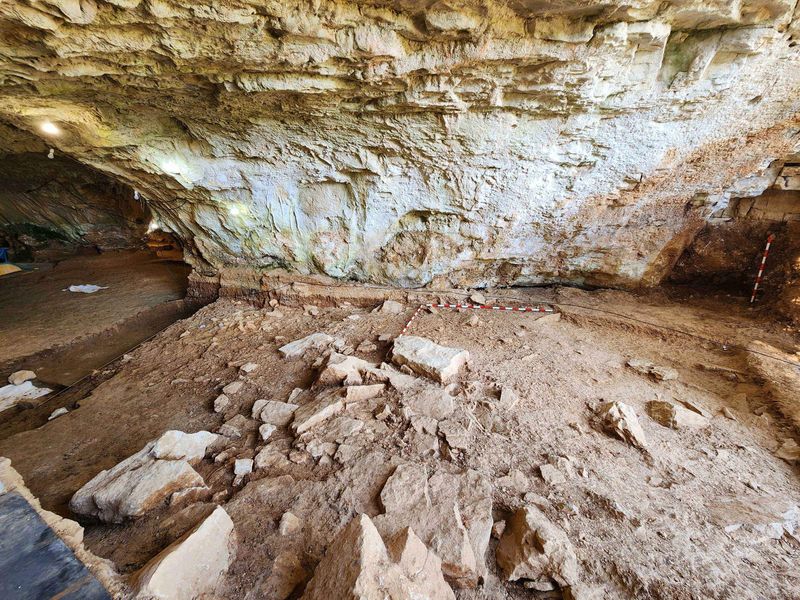
The archaeological evidence is just as thorny as the written sources. If so-called “Sea Peoples” were responsible for a multi-civilizational collapse, you’d expect to see countless cities laid to ruin around the Eastern Mediterranean. Certainly, the region isn’t in shortage of incredible archaeological sites, but they don’t quite fit into this narrative.
“We have a habit, when we talk about ancient history, to oversimplify what is happening across vast swathes of the ancient world, compressing both space and time. While we do see social and political changes during the 12th century across much of the eastern Mediterranean, each context is different and has its own nuances,” the Bad Ancient team explains.
We should also reconsider the concept of ‘the collapse of civilizations’.
Bad Ancient
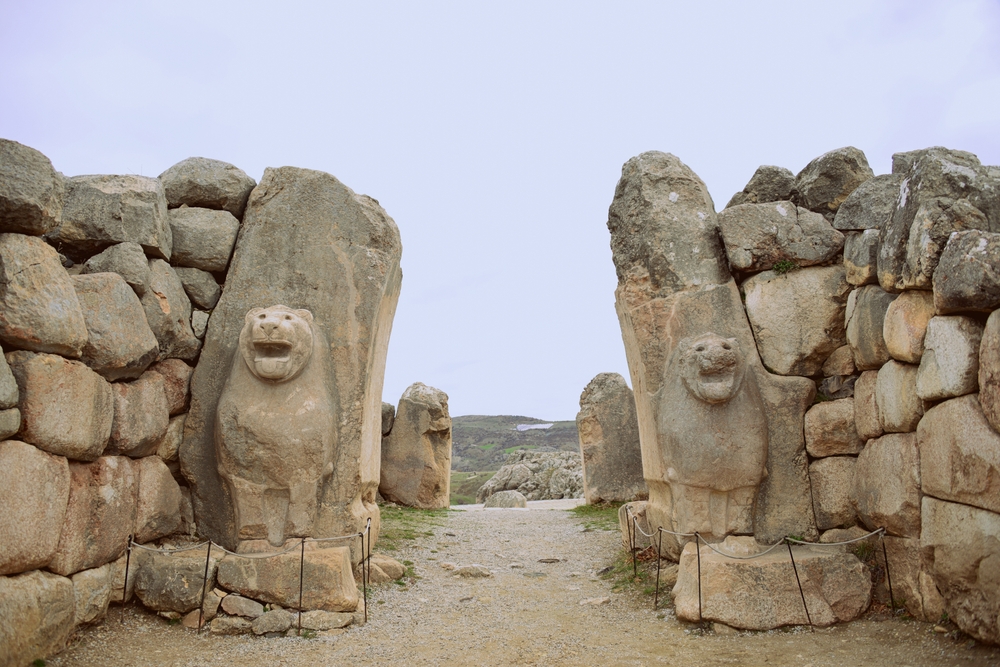
They note how in parts of the Eastern Mediterranean that fell, such as Mycenaean Greece and the Hittite Kingdom in Anatolia, there’s little clear evidence that outside invaders suddenly came, saw, and conquered.
On the other hand, we do see some evidence of a terrible invasion in parts of Western Asia, most notably the city of Ugarit in present-day Syria. However, even these examples are not as black-and-white as modern myths suggest.
“There is some evidence for slow change in the Eastern Mediterranean, and there are some sites which show clear signs of conflict. While many people would prefer a simplistic narrative answer, this doesn’t do credit to the complexities of the archaeological evidence, nor the reality of lived human experiences,” the team notes.
The archaeological record also tells us that many of these civilizations that apparently "collapsed" didn't simply turn to dust over one night; they witnessed profound changes that transformed and mutated the culture in a slow unravelling.
"We should also reconsider the concept of ‘the collapse of civilisations’. The Hittite civilisation continues, in a changed form, after the ‘collapse’," they point out.
"In Greece, too, Mycenaean civilisation persists for another century in which new, smaller buildings are erected on the remains of the palaces until eventually it seems people start to do something new [...] Migration, invasion, and warfare are one part of this process, but they are not the One Neat Trick that explains the Bronze Age collapse."
What did trigger the late Bronze Age Collapse, then?
To put all this another way, there was not a single invasive force that brought the Eastern Mediterranean to its knees around the year 1177 BCE.
Just look at what certain politicians and pundits peddle as a way of explaining the hardships experienced by certain strata of modern society. Simplistic narratives are always suspect.
Bad Ancient
Instead, what we see is a multi-dimensional system collapse primarily driven by natural forces, such as sudden climate shifts, earthquakes, and disease, as well as human-driven changes, such as war and technological shifts.
Sea-borne invaders might have played a cameo within the mess, but they were not the superstars.
“The fact that we are still trying to insert them into this narrative is, in part, a hangover of a tradition that dates back to the 19th and early 20th centuries. In reality, civilisational collapse cannot be explained simply in the terms of an invasion,” Bad Ancient added.
“Just look at what certain politicians and pundits peddle as a way of explaining the hardships experienced by certain strata of modern society. Simplistic narratives are always suspect."
Nolan's big twist
As for the twist at the end of Nolan’s movie — ***SPOILER ALERT*** – that Odysseus and his returning soldiers were, in fact, the hell-raising Sea Peoples themselves, the Bad Ancient team is doubly skeptical.
In the film, Odysseus mentions the ending of the ’Age of Bronze’, which is jarring. It is an attempt to historicise the story, in a film that proudly contains monsters, sirens and witches – it does not fit.
Bad Ancient
It could, they say, be a clever nod to a persistent yet controversial theory that some of the “Sea Peoples” inferred in the Egyptian inscriptions were actually Greek.
However, they suspect this might be giving Nolan more credit than he's due. By trying to tether a myth to real historical events, the director is arguably doing the story a disservice by "demythologizing" it, in a sense. In actuality, they suggest, it would be better to present The Odyssey as a brilliant tale full of strange and vibrant supernatural forces, not a rational regurgitation of reality.
"In the film, Odysseus also mentions the ending of the ’Age of Bronze’, which is again jarring. It is an attempt to historicise the story, in a film that proudly contains monsters, sirens and witches – it does not fit," the trio explains.
“Rather than accept that ancient Greeks can come up with stories ie. a centaur or a trick involving a large wooden horse, we instead try to come up with what could have possibly inspired such flights of fancy: a steppe horseman in the case of the former and some kind of battering ram for the latter,” they conclude.
“All intended, it seems, to undermine the human faculty of the imagination. Were Tolkien’s Ents merely people who lived in trees? Of course, this way madness lies: sometimes a cigar is just a cigar.”