Nature
 PUBLISHED


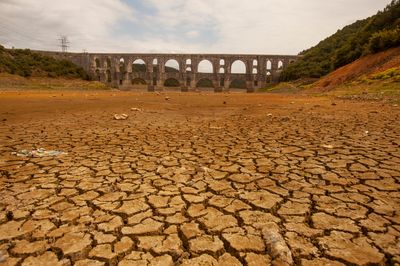


Around 3,200 years ago, multiple civilizations in and around the Mediterranean fell, an event known as the Late Bronze Age (LBA) Collapse. It has not escaped historians’ notice that the events thought to have inspired Homer’s Iliad and Odyssey probably occurred around the same time.
Subsequent generations looked back at the pre-collapse period as a golden age, worthy of commemoration in heroic tales, but it was probably brought undone not by warring gods and stolen wives, but by extended drought. New work explains the underlying causes.
Bronze Age technologies made the transportation of large amounts of food difficult, so when natural disasters struck, hunger and war formed a vicious cycle that could end entire civilizations. Archaeologists have often found signs of drought preceding the fall or great cities, but have seldom known why a period was dangerously dry.
Stockholm University PhD student Katherine Power has been seeking answers, and found answers in advanced climate models.
"Rather than being caused by a single climatic event, we found that the most extreme droughts emerged when natural climate cycles operating over different timescales coincided. This helps explain why the droughts associated with the Late Bronze Age collapse were so severe," Power said in a statement.
Power and Professor Qiong Zhang ran the EC-Earth 3.3.1 climate model, used for predicting future planetary conditions, back 8,000 years to see how the Mediterranean changed in that time.
"Our results show that the region underwent a gradual drying trend over thousands of years, driven by slow changes in Earth's orbit. Superimposed on this long-term trend, we also found shorter-term fluctuations in the Atlantic Ocean and atmosphere," Power said.
The shift driven by planetary forces was slow enough that civilizations could adapt, and parts of the region showed no overall trend anyway. On the other hand, shorter cycles, driven by forces such as in the Atlantic Meridional Overturning Circulation (AMOC) and Mediterranean salinity levels could take people by surprise, and sometimes affected larger areas at once, potentially leading to cascading effects.
Moreover, peaks or troughs from cycles of different length sometime coincided, creating three multi-century dry periods across the Eastern Mediterranean, the most recent of which coincides with the LBA Collapse.
Although a long dry era more than 2,000 years earlier was even more intense and widespread, according to the model, than the big dry of Odysseus’ day, the impact had probably been wiped from the collective memory long before. To people living through it, this would have seemed an era of unprecedented hardship, as if the gods had been displeased.
According to EC-Earth 3.3.1, the Balkans began drying out around 3,400 years ago. By 1100 BCE declining rainfall was much more widespread, and by 1050 BCE the region was also getting colder. The model’s output closely matches proxy records from sources such as stalactites, where these exist, which in some cases show 15-30 percent declines in rainfall at this time.
"The convergence of these processes pushed the Eastern Mediterranean beyond a critical hydroclimatic threshold, reducing water availability and increasing pressure on agriculture and food security within already vulnerable societies," Power said.
“With ecosystems and agricultural systems operating close to moisture thresholds, relatively modest shifts in the balance between precipitation and evaporative demand can trigger nonlinear responses in vegetation, food production, and resource stability,” Power and Zhang write.
There is so much magic and myth in Homer’s epics that 19th century historians considered them entirely fanciful, until the remains of an ancient city were found near the Dardanelles, where Greeks hundreds of years later thought Troy had stood.
That city preserves evidence of being destroyed at least nine times over 3,000 years, including a major burning around 1180 BCE, quite close to when many historians of Ancient Greece’s golden age placed the Trojan War. That, in turn, coincides with the LBA Collapse, as civilizations fell, or at least stumbled, in Greece, Egypt, what is now Turkey, and the Balkans.
The subsequent Greek Dark Ages lasted almost 400 years; neighboring states also took centuries to recover their previous glory. Changes to technology and assaults by the so-called Sea Peoples have been blamed for these near-simultaneous collapses. Maritime invaders probably played a part, but if so their appearance may have been partially driven by climate conditions in their homelands.
Meanwhile, crop failure made civilizations that had previously been easily able to defend more vulnerable.
"The Mediterranean is one of the world's climate change hotspots and the area is projected to become warmer and drier during the coming century. Our findings suggest that future drought risk may depend not only on long-term human-driven warming, but also on how natural variability in the Atlantic Ocean interacts with that background trend," Power said, although the paper indicates more work is needed to understand how that will probably pan out.
The study is published open access in Science Advances.