Nature
 PUBLISHED


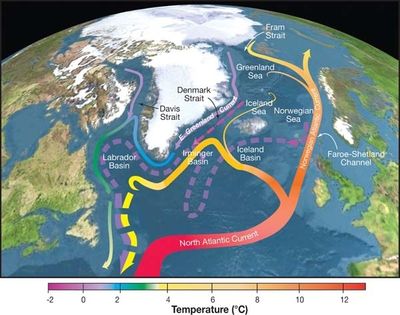


The Atlantic Meridional Overturning Circulation (AMOC), responsible for the fact that Britain and Scandinavia are habitable, is fraying at its western boundary, new research indicates. Although prospects are better on the eastern side of the mighty ocean current, the overall trend is deeply worrying.
The study makes use of the fact that the AMOC is not just the associated Gulf Stream’s northerly flow of warm water, the component that affects us most directly, but the return flow of colder water. The movement of cold, relatively fresh water downwards and the corresponding uplift subtly change the pressure at great depths. This interchange is even more important in the long run, since it drives the redistribution of water around the planet, bringing nutrients to the surface in places where upwellings make the marine food chain possible.
For decades, one of the biggest unknowns in climate science is whether global heating would turn off the AMOC. There is plenty of evidence this happened before, as the world was leaving the last ice age, and possibly on other occasions. These disruptions to the AMOC interrupted the flow of warm water to the north Atlantic, sending temperatures in what is now the UK, Ireland, and Scandinavia plunging to match those in Canada at the same latitudes.
Competing models have produced contrasting results, some predicting sudden collapse, others a slow decline we’d at least have time to adapt to, and some suggesting little change. Direct measurements of the AMOC’s strength have been similarly confusing, with results differing depending on where they were taken. A novel technique represents another flashing warning sign.
Unfortunately, even though it’s 22 years since The Day After Tomorrow alerted the general public to the possibility of AMOC collapse, albeit in a completely unrealistic manner, long term data is lacking. We haven’t been observing the water movements in many places long enough to give us a picture not distorted by brief fluctuations.
An alternative way to measure what is happening to the AMOC is to measure ocean bottom pressure (OBP). The researchers chose the western boundary to study because it seems to be where changes showed up first during previous collapses, and combined 22 years of data from four sensors moored to the Atlantic floor from 16.5°N to 42.5°N.
Although data isn’t available from all four over that time, the trend is down in each, suggesting the western edge of the AMOC has weakened significantly this century.
Although the authors think there may have been some strengthening in the east, this would not be enough to prevent an overall decline in the AMOC’s movement of heat and water over more than two decades.
The authors don’t think their work will be the last word on the question – with the climate of hundreds of millions of people at stake it’s hardly likely to be. They propose continued monitoring of pressure at and below 1,000 meters (3,300 feet) beneath the surface, at both boundaries of the AMOC. Nevertheless, the work is another weight added to the grim side of the scales.
One reason uncertainty has continued about the risk of AMOC collapse is that the northern branch, known as the Nordic Seas Overturning Circulation (NOC), appears to be growing stronger. However, new work suggests that might be just what we would expect.
“The stability of the NOC and its projected increase have been viewed by some as a contradiction to the weakening AMOC. But our findings tell us the opposite. The strengthening of the NOC is a physical consequence of AMOC weakening,” said study coauthor Stefan Rahmstorf of the Potsdam Institute for Climate Impact Research in a statement.
A recent paper found that if the AMOC does collapse, there will be an additional negative consequence that has not previously been recognized. The collapse would affect the global carbon cycle, and cause the Southern Ocean to start releasing, rather than capturing, carbon dioxide into the atmosphere. This would warm the planet 0.17°C to 0.27°C (0.3-0.49 °F) beyond existing estimates, the paper concludes.
The AMOC study is published in Science Advances, while the work on the NOC is published in Ocean Science.