Space and Physics
 PUBLISHED


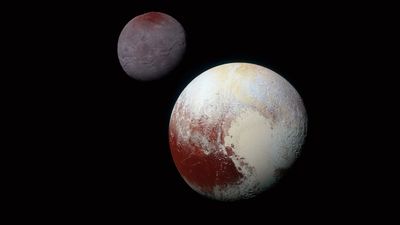


People might disagree on whether Pluto should be considered a planet or a dwarf planet but no one disagrees that this world is peculiar. Everything about it is so weird, from its heart to the fact that occasionally in its 248-year orbital period – of which it has yet to complete a full orbit since its discovery – it is closer to the Sun than Neptune.
Among the quirky characteristics of this distant dwarf planet are its moons and the way they orbit Pluto – or to be more precise, the way they don’t. They all orbit a point outside of Pluto, and Charon, its largest moon, is to blame.
You see, Charon has about half the diameter of Pluto and about one-eighth of its mass. This is so big that the barycenter of this system – the point around which objects in a system orbit – is actually 960 kilometers (about 600 miles) from the surface of Pluto, which is really far from the dwarf planet, about 83 percent of its radius.
Jupiter also technically doesn’t orbit the Sun, but given its size and distance from the Sun, it orbits a point just out of its surface, about 7 percent of the radius of the Sun. Pluto and Charon are also tidally locked with each other, which means they are always showing the same face as they perform this dance.
At the International Astronomical Union meeting (IAU) in 2006, the infamous meeting where the category of "dwarf planet" was created and Pluto was reclassified, there was a proposal to start calling Pluto and Charon a double planet. It ultimately didn't go anywhere, but some people do still refer to the pair as a double dwarf planet.
Pluto has five moons, though Charon hogs most of the headlines: Stix, Nix, Kerberos, and Hydra make up the other four. All are tiny and irregularly shaped. Their orbital plane is consistent with the equator of Pluto, and scientists believe they are the result of a collision between Pluto and an object of comparable size, from which these chunks of space rock and ice formed.
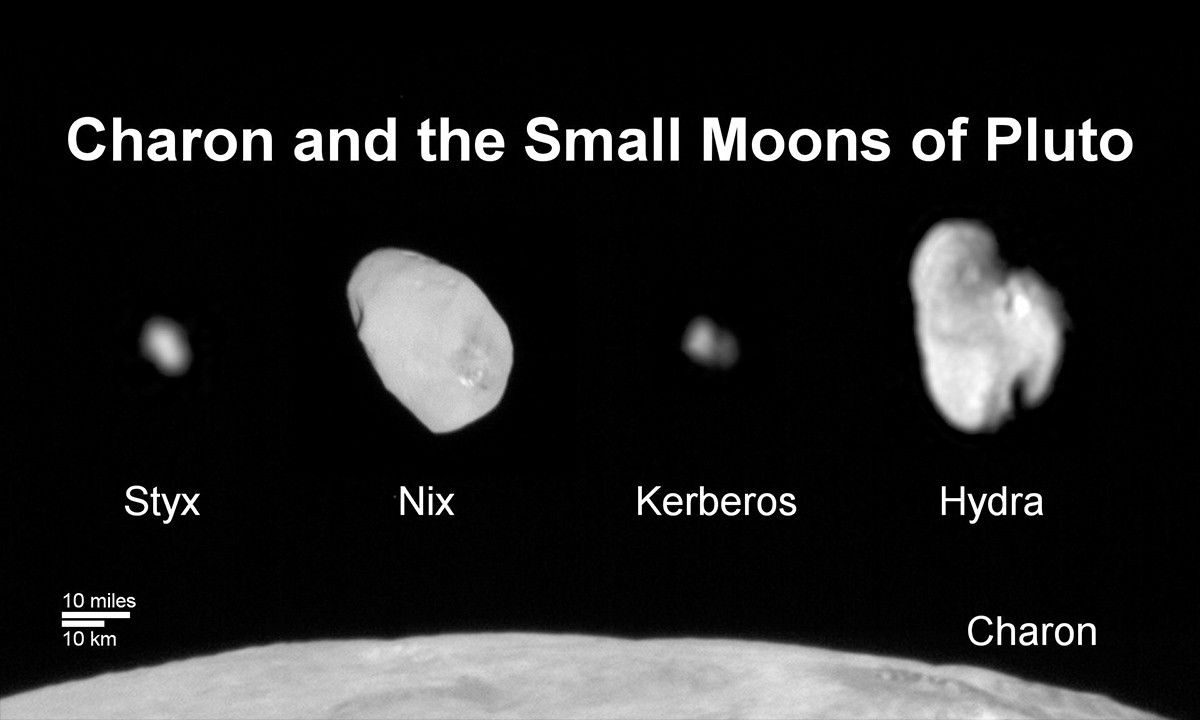
The orbits of these four tiny worlds are very close to circular and at their center, Pluto... isn't. Instead, it is the barycenter between Pluto and Charon that they orbit instead. This complex and peculiar dance gives rise to almost perfect patterns in their orbits. The periods of Styx, Nix, Kerberos, and Hydra are in a 3:4:5:6 pattern with that of Charon. That means that for every 60 orbits of Charon, Styx does 20, Nix, does 15, Kerberos does 12, and Hydra does 10.
There are more peculiar movements and influences between these bodies; this cosmic ballet is a whole production in itself, and yet, it's a very successful one.
Pluto was discovered by American astronomer Clyde Tombaugh of the Lowell Observatory in Arizona in 1930. It's the only planet discovered by an American, perhaps one of the reasons Americans particularly want to see it reinstated to full planetary status – more on that in a bit.
Since 1930, Pluto has not actually completed a full orbit of the Sun. Its orbital period is 248 Earth years, and it will finally complete a full turn on March 23, 2178. Curiously, though, thanks to its highly elliptical and tilted orbit compared to the orbital plane of the other planets, Pluto spends 20 years of its orbit inside Neptune's orbit, meaning for that period, it is closer to the Sun than Neptune. The last time it did this was in 1979 and 1999. The next time will be in 2227.
The potential reinstatement of Pluto as a planet is once again a hot topic as current NASA Administrator Jared Isaacman has proclaimed himself “very much in the camp of 'make Pluto a planet again'" as recently as the Congressional hearings over the budget – and fate – of NASA occurring this week.
There are many reasons why, even as NASA Chief, Issacman can't do that, not least because the status of celestial objects lies with the IAU, a global society of professional astronomers that defines these objects and assigns official names to them and their surface features. For example, the Artemis II astronauts recently requested to name a crater on the Moon Carrol Crater, after Commander Reid Wiseman's late wife. However, NASA can't sign off on that; it has been submitted to the IAU.
"[W]e are doing some papers right now on, I think, a position that we would love to escalate through the scientific community to revisit this discussion and ensure that Clyde Tombaugh gets the credit he received once and rightfully deserves to receive again," Isaacman said at the hearing. Whether a successful case will be put forward, we'll have to wait and see.
This article has been updated with new and relevant information from an earlier article from 2023.