Nature
 PUBLISHED
 1
1


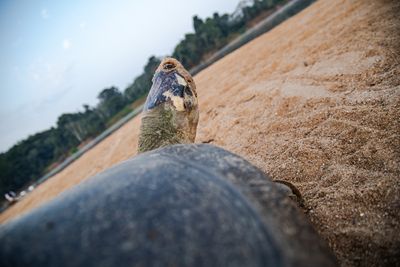


Counting wildlife is a tricky business, especially when the subject of your count has a tendency to swim away every now and then. However by combining aerial imagery with modeling, researchers have counted over 41,000 giant South American river turtles, representing the largest turtle nesting site in the world.
On the Guaporé River sandbanks between Brazil and Bolivia, giant South American river turtle (Podocnemis expansa) females congregate each year between July and August to lay their eggs. These mass nesting events used to be common, but have declined due to the overexploitation of the animals for meat and eggs.
The team flew drones above this nesting site and then created orthomosaics, which are made by combining hundreds of overlapping aerial photographs together. Orthomosaics are helpful for researchers since they are less invasive, quicker, and more accurate than previous methods, such as counting the hatchlings or visual counts of the adults. However, just using these composite photographs doesn't account for the turtles moving around.
To combat this the team came up with a combination approach. They painted white marks on the shells of over 1,000 turtles on one specific sandbank. Over a period of 12 days, a drone flew over this area, taking 1,500 images during each of the four passes of the sandbank that it made daily. The researchers then combined the photographs and looked at whether the turtles were moving or nesting, and if their shells bore white paint or not.
With all of this information they could then create models that accounted for the movements of the turtles into and away from the sandbank. When comparing the numbers of the models against people counting on the ground and those who reviewed just the orthomosaics, each group came up with a widely different number, largely due to counting the same individuals, which can appear up to seven times in the mosaic counts.
“These numbers vary greatly, and that’s a problem for conservationists,” said Ismael Brack, a postdoctoral researcher within the University of Florida Institute of Food and Agricultural Sciences’ (UF/IFAS) School of Forest, Fisheries and Geomatics Sciences, in a statement. “If scientists are unable to establish an accurate count of individuals of a species, how will they know if the population is in decline or whether efforts to protect it are successful?”
“The total population size was estimated as ~41,000 turtles for the 12 days of nesting season, marking the current world's largest known aggregation of freshwater turtles,” explained the authors in the paper.
The team even think that this method could be applied to other species in the future.
The study is published in the Journal of Applied Ecology.