Space and Physics
 PUBLISHED
 8
8



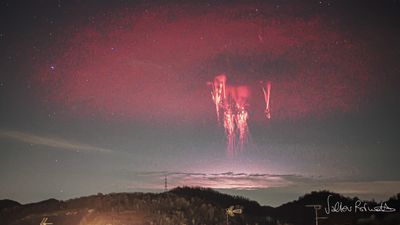


A few weeks ago, a particularly strong lightning bolt was released over the Adriatic Sea, between the Italian and Balkan Peninsula. The electric field spread across the atmosphere, traveling hundreds of kilometers, where, above the Northern Italian town of Possagno, not too far from Venice, not one but two rare atmospheric phenomena took place. Incredibly, they were both captured in a photograph at the same time.
The amazing shot was captured by Valter Binotto, an Italian photographer who has not only previously won the Wildlife Photographer of the Year Award, but he's also talented at capturing elusive atmospheric events.
The red, disk-like structure is known as an ELVE, or an Emission of Light and Very low-frequency perturbations due to Electromagnetic pulse sources. It's one of those backronyms that you just need to accept. The red, tentacular, jellyfish-like flash is known as a sprite.
Since I started more than 10 years ago, I have photographed hundreds of sprites. ELVEs are very rare and therefore more difficult to photograph.
Valter Binotto
If you are wondering if everything is named after some sort of folklore creature, you’d be mostly right. There are TROLLs, Pixies, GHOSTs, and Gnomes, but also blue jets. All of these are Transient Luminous Events, very fast, very bright phenomena similar to lightning happening in the upper atmosphere. They are associated with thunderstorms, quite serendipitously, but remain mysterious as they are difficult to study.
“This is a rare duo lineup of Sprite and ELVE. Sprite is the red tentacle object at the center. The red ‘flying saucer’ around them is the ELVE,” Binotto wrote on Instagram.
“ELVEs occur when an unusually powerful lightning strike generates an intense electromagnetic impulse (EMP). The red ring indicates the point where the EMP hit the Earth’s ionosphere.”
The color of both these atmospheric phenomena is due to the excitation of nitrogen particles in the upper atmosphere. The lower edges of northern lights can also become red due to the nitrogen, but the excitation there comes from space. They are rare, but this photographer’s work shows that with patience and dedication, they can be captured. Binotto uses a camera modified for astrophotography, which is more sensitive to infrared light.
“Since I started more than 10 years ago, I have photographed hundreds of sprites. ELVEs, on the other hand, only three — including this one, which is a double event of sprites and ELVEs. ELVEs are very rare and therefore more difficult to photograph,” Binotto told IFLScience.
ELVEs were only discovered in 1990 by the crew of Space Shuttle Discovery on the mission that sent the Ulysses probe to study the Sun. They are flat and can extend for hundreds of kilometers in the ionosphere, and for this reason, Binotto compared them to the Alien Mothership in Independence Day.
We've only known that sprites exist for marginally longer, as they were first photographed in 1989. Red sprites are electrical discharges similar to lightning, but they do not come towards the ground; they go up into the atmosphere, reaching 50 to 90 kilometers (30 to 55 miles) – almost the conventional edge of space.
Both these phenomena are extremely fast too, lasting just milliseconds, so can be difficult to photograph.
“If someone wanted to start now, it is much easier than when I began. Back then, there was nothing that explained how to do it. I recommend this website, where you can find all the explanations about the phenomena and how to photograph them,” Binotto told IFLScience.
May we have many more pictures of these fantastic and mysterious events in the future.