Space and Physics
 PUBLISHED
 7
7


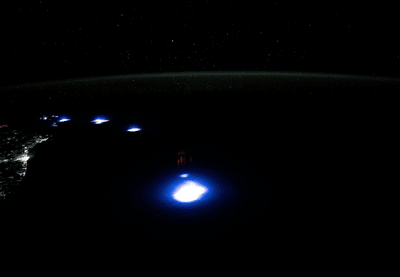


While looking down at his home planet, astronaut Matthew Dominick spotted a flurry of colorful bursts of energy dancing in Earth’s upper atmosphere.
The spectacular light show was photographed on June 3 as the International Space Station (ISS) cruised over thunderstorms off the coast of South Africa, according to NASA.
Known as transient luminous events (TLE), they usually occur in the upper atmosphere when thunderstorm lightning is raging below. This particular image also shows a specific form of TLE known as red sprites, luminous red-orange flashes that occur at altitudes of 50 to 90 kilometers (31 to 56 miles).
The red color is due to nitrogen in the atmosphere interacting with an electric charge, such as those present in lightning storms. When nitrogen meets the electric charge – boom! – it lets out a red glow in the form of plumes and spiny tendrils.

Studies have also indicated that sprites are associated with gravity waves, tiny ripples in the very fabric of spacetime created by violent cosmic events, although the nature of the link is not fully understood.
Red sprites and other TLEs can occasionally be spotted from Earth’s surface under the right conditions, although they’re not always visible because they're so high up in Earth’s atmosphere. They’re best seen from high-altitude planes or, better still, an object in low-Earth orbit like the ISS. These events only last for a split second, so it's easier for astronauts to catch them on camera using long exposures.
Earth isn’t the only planet that experiences sprites. Astronomers have also observed the lightning-like electrical outbursts on Jupiter. Here, the upper atmosphere of the planet is abundant in hydrogen, as opposed to nitrogen, so the sprites tend to appear blue rather than red.
Scientists don’t fully how, when, and why sprites form on Earth. To find out, they might need your help. In 2022, NASA launched a citizen science project called Spritacular that asked the public to upload their images of sprites into an online database.
“People capture wonderful images of sprites, but they’re shared sporadically over the internet and most of the scientific community is unaware of these captures,” Dr Burcu Kosar, a space physicist at NASA’s Goddard Space Flight Center in Greenbelt, Maryland and Spritacular principal investigator, said in a statement at the time.
“Spritacular will bridge this gap by creating the first crowdsourced database of sprites and other TLEs that is accessible and readily available for scientific research,” the scientist added.