Nature
 PUBLISHED


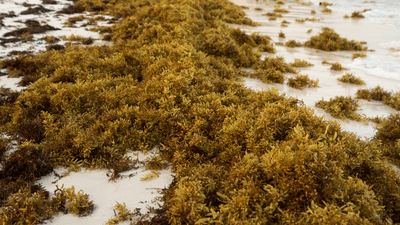


Hold onto your butts, it’s sargassum season and this year it’s set to be bigger than ever. Yes, those giant, stinking blobs of living organisms have once again set sail, and strong winds mean they’re likely to be causing a nuisance earlier than usual. According to the University of South Florida, a "record-high Sargassum amount in most regions" means "2026 is very likely another major Sargassum year."
Sargassum is a kind of brown algae that forms massive, island-like mats of seaweed in open water. It’s the namesake of the Sargassum sea, known as the “golden floating rainforest” that spans roughly 5.2 million square kilometers (2 million square miles) in the North Atlantic Ocean.
While there are lots of types of algae that float in the ocean, what sets sargassum apart is that it is holopelagic, meaning it spends its entire life drifting at the surface rather than being attached to the seabed. It’s a natural feature of the ocean, but a combination of nutrient runoff, shifting ocean currents, and climate change has seen the volume of sargassum increasing year-on-year since 2011.
As oceanographer and Sargassum expert Dr Tracy Fanara told Weather.com, this is the result of an anomalous wind pattern that brought sargassum south. Thriving in the warmer waters, it formed a new region known as the Great Atlantic Sargassum Belt that sends giant blobs of seaweed to beaches in the Caribbean, Mexico, and the Florida and Gulf coasts.
“2018 was our big, eye-opening growth moment,” said Fanara. “I think we got up to 20 million tons. And then last year, it broke records again at 38 million tons, if I recall correctly. And this year we're on track at this rate to beat that.”
Ever since the 1958 movie, The Blob, we’ve all been drawn to tales of giant, invasive masses glooping their way across the landscape, but sargassum is a real problem. Beyond the significant impact on economies, sargassum releases hydrogen sulfide and ammonia as it breaks down, which can cause respiratory issues.
Sargassum mounds attract sea lice – a kind of jellyfish larvae that can cause a nasty rash if you come into contact with them. They also accumulate pollutants and can contain flesh-eating bacteria. So, in case the smell isn’t enough to put you off, steer well clear of these giant seaweed blobs.
It’s a big problem for which we’ve yet to come up with a realistic solution because sargassum blooms are driven by so many factors.
“We can’t blame the record high levels of sargassum on just one thing,” said Fanara. “It's a number of different ecological factors and physical factors that results in an event like this.”
“Saharan dust nutrient runoff can be contributing in addition to those warming waters. There might've been an upwelling event that brought nutrients to the surface, further feeding that algae. So, there's a number of different ways that these algae can get nutrients and grow in this environment.”
Steel yourselves, Florida. While we wait for a way out of this environmental disaster, the sargassum is coming.