Nature
 PUBLISHED


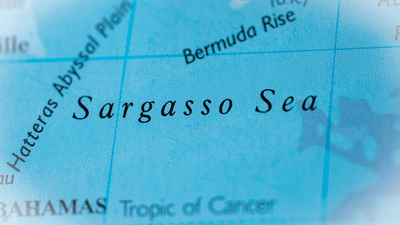


If I were to ask you to point out the Sargasso Sea on a globe, which country are you headed for? Coming up empty? In a way, you're right, as it’s the only sea on planet Earth that has no land boundary.
You’ll find it in the North Atlantic Ocean, sitting east of the United States and surrounding the island of Bermuda. Ironic, really, that everyone thinks the myth-laden Bermuda Triangle is such a big ocean mystery. The Sargasso Sea is really much weirder.
Known as the “golden floating rainforest,” it spans roughly 5.2 million square kilometers (2 million square miles) in the North Atlantic Ocean. Its name comes from a genus of free-floating seaweed called Sargassum, of which it’s home to two species: Sargassum fluitans and Sargassum natans.
This is another unusual feature of the Sargasso Sea. While many types of algae float in the ocean, these Sargassum species are known as “holopelagic”, meaning they spend their entire life drifting at the surface rather than attached to the seabed.
Instead of starting life on the ocean floor, they mainly reproduce vegetatively on the open sea. Pieces of the seaweed break off and continue growing as new individuals. This means a single clump can turn into many more simply by splitting and growing.
The size of the sargassum mats varies throughout the year, but they can range from small patches to sprawling, interconnected structures that stretch for miles. They form part of the Great Atlantic Sargassum Belt, an 8,000-kilometer (5,000-mile) long sargassum bloom that recurs in the Atlantic Ocean and is the largest macroalgae bloom in the world.
You can see, then, why people compare the Sargasso Sea to a golden floating rainforest, and the animal activity going on here only further cements that reputation.
In 2022, a seismic discovery answered a question that had plagued minds for millennia: where do eels reproduce? The world-first research tracked the epic journey of the European eel to its spawning area in the Sargasso Sea, marking a pivotal achievement in our understanding of eel reproduction. Researchers had long wondered where they spawned – and, being animals that flit between fresh and saltwater habitats like it’s no big deal, how on Earth they get there.
Cracking the case involved fitting 26 female European eels (Anguilla anguilla) with satellite tags back in 2018 and 2019. They were set loose in the Azores, feeding into the Atlantic Ocean, marking the furthest known point along the eel migration route for these animals to travel to the Sargasso Sea.
Of those 26 eels, 23 returned data across a period of six to 12 months. Just three made it to the Sargasso Sea. Incredibly, it was revealed that the migration to this significant spawning site takes over a year for adult eels.
Seems like a lot of effort to reach some seaweed, but the Sargasso Sea is a hot hangout for juvenile turtles, too. Another mystery that had plagued marine scientists was figuring out where young turtles went during their “lost years” between hatchling and adult.
Attaching trackers to fledgling turtles would seem like an obvious solution, but it’s not so easy with turtles whose shells change size and peel. The team consulted with manicurists (turtle shells are made of keratin, like human nails) and dentists (crown adhesive is powerful stuff), until eventually they settled on a marine adhesive that would get the job done.
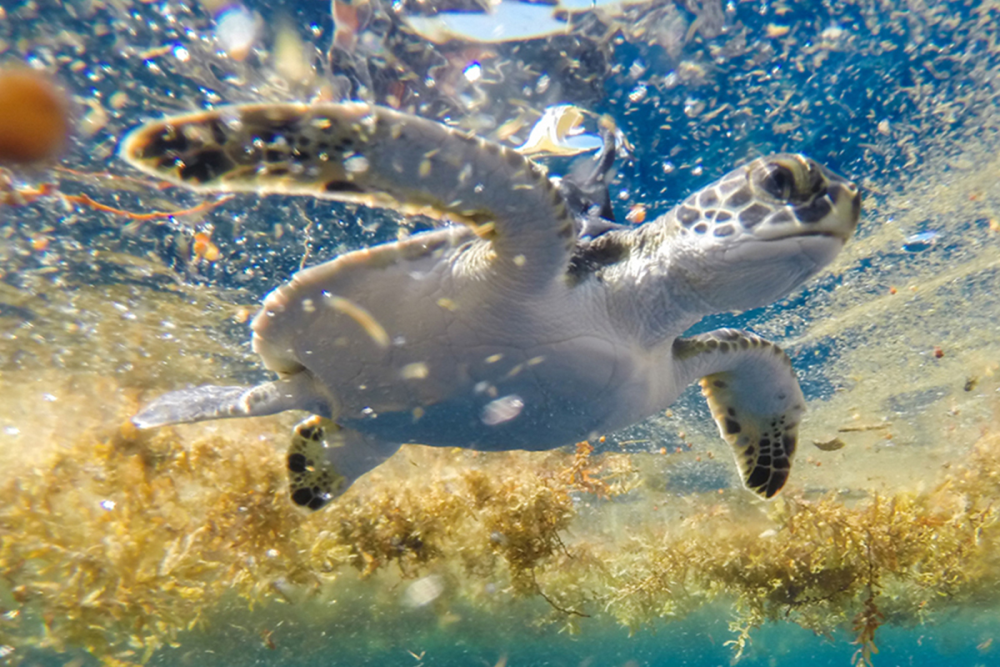
Armed and ready, they fitted the gluey tracker backpacks to 21 young green turtles and sat back to see where the adventure would take them. Their tracking data revealed that the Gulf Stream was a popular ride, taking many of the study’s turtles north, but 14 of the 21 peeled off to make their way to the Sargasso Sea. So, why is it such a sweet spot?
“The Sargasso Sea is named for the large mats of brown, floating algae (called Sargassum) that aggregates there,” lead author Kate Mansfield told IFLScience. “Young, oceanic stage loggerhead and green sea turtles are known to associate with Sargassum. This habitat provides them with a bit of protection from predators (young turtles and loggerheads in particular blend in well with this algae due to their coloration) and plenty of available food.”
“Larval and juvenile fish live in the Sargassum, as do little crustaceans (crabs, etc), some algae, etc. All things that these little turtles likely eat. It also provides warmth – the brown algae traps water and the sun helps warm things up a bit relative to the open ocean. So, for little cold-blooded turtles, this may give them an advantage in terms of their metabolism and growth."
It’s yet another of the Sargasso Sea’s mysteries that it can support so much sargassum and wildlife, given it was described by John Ryther, a biological oceanographer at the Woods Hole Oceanographic Institution, as a “biological desert”. The water here is low enough in nutrients to class it as oligotrophic, and yet year-on-year the sargassum party continues.
Sargassum production has become problematic in a few ways in recent years. With stinking blobs floating their way to areas like Florida, they’re now interrupting hatchling sea turtles’ dash to the ocean. How do you do it, Sargasso Sea?