Nature
 PUBLISHED
 1
1




February 2 marks the celebration of a bizarre tradition in the small town of Punxsutawney, Pennsylvania (and a growing number of other places in North America). Every year for the last 140 years, an apparently immortal groundhog named Phil waddles out of his burrow, Gobbler’s Knob (yep, real name), and predicts whether or not there’ll be six more weeks of winter – as translated by the president of the Inner Circle, who can understand “Groundhogese” thanks to a special cane (again, not joking).
If all that sounds like a load of unhinged baloney, you’d be correct. Even if groundhog-human communications were possible, Phil still wouldn’t have a great reputation as a meteorologist; his “forecasts” over the last 10 years have only been right 30 percent of the time.
The famed woodchuck isn’t the only animal that’s been revered for their apparent weather forecasting skills. According to folklore, the length of the black and brown bands on a woolly bear caterpillar – the larval form of the Isabella tiger moth (Pyrrharctia isabella) – can predict how harsh the upcoming winter will be. As cute as it would be to have a fuzzy little creature tell the weather, there’s no scientific evidence to suggest this is true.
It does beg the question, though: are there any animals that actually can predict the weather? Caterpillars and rodents might not be having much success, but it turns out that birds might be a better bet.
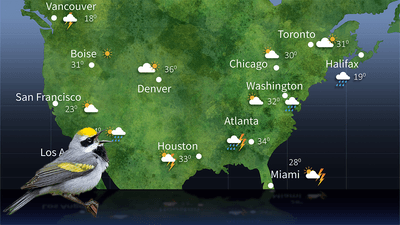
Golden-winged warblers, for example, might be able to sense that a big storm is coming. In 2014, researchers who’d been tracking the birds in the Tennessee mountains discovered that they had flown away from their breeding grounds outside of the usual migration season – two days before the arrival of a deadly storm system that spawned 84 tornadoes.
“We know that birds can alter their route to avoid things during regular migration, but it hadn’t been shown until our study that they would leave once the migration is over and they’d established their breeding territory to escape severe weather,” team lead Henry Streby said at the time. “The warblers in our study flew at least 1,500 kilometers (932 miles) total to avoid a severe weather system. They then came right back home after the storm passed.”
The team suspects that the birds were able to hear the infrasound – that’s sound with a wave frequency below 20 Hertz, which humans can’t hear – generated by the storm system and took that as a sign to get the hell out.
Perhaps even more impressive is the veery, a small species of North American thrush whose breeding behavior appears to be a predictor of the intensity of the Atlantic hurricane season.
In 2019, ornithologist Christopher Heckscher conducted an analysis that found in years where the hurricane season had been milder, the veeries’ breeding season had been longer. Conversely, the season was shorter when the hurricane season was more intense.
In fact, Heckscher’s study found that the birds’ egg laying and eventual clutch size in May and June “showed stronger correlations with subsequent hurricanes than early season (prior to August) meteorological predictions widely publicized by CSU, NOAA, and TSR”.
Quite how the veery does this is unclear. “Whatever it is, they know by mid-May,” the ornithologist told Audubon Magazine. “It sounds out there, but then again if you think about it, it makes sense these birds would take advantage of anything they could across their evolutionary history to avoid hurricanes.”
Maybe it’s time we listened to the birds instead – they certainly seem to be making better guesses than Phil.
An earlier version of this article was published in January 2025.