Nature
 PUBLISHED


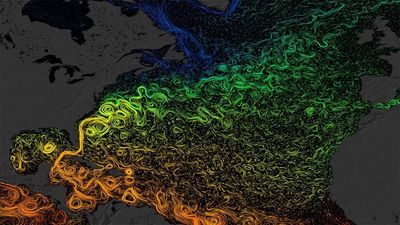


The Atlantic Meridional Overturning Circulation (AMOC) – the mega highway of ocean currents that shifts heat, carbon, and nutrients around the Atlantic Ocean – may act like a key “heat valve” on the world’s temperatures.
What is the AMOC?
To wind back a bit and provide some context, the AMOC is a circuit of ocean currents that carries warm, salty surface water northwards from the tropics up into the North Atlantic, where it cools, sinks, and flows back southwards at depth. The cycle continues, looping back around, in a circulating system.
Over the past few years, a considerable number of studies have suggested that the AMOC is slowing down and weakening as a result of warming temperatures.
The idea is that freshwater from the thawing Greenland ice sheet is diluting the salty water in the Atlantic that normally sinks and drives the current back south. This, in theory, could put the brakes on the giant circulatory system, eventually stopping heat from being carried back to higher latitudes.
The Day After Tomorrow
Some have even suggested the entire AMOC could be on course for total collapse, although the Intergovernmental Panel on Climate Change suggests this "tipping point" is unlikely to happen before 2100.
Nevertheless, a weakening AMOC would potentially bring extreme cold weather to the parts of the North Atlantic that rely on the currents to receive heat, such as Northeast North America, Northwestern Europe, and Greenland.
This idea is a key premise of the 2004 blockbuster The Day After Tomorrow, in which the Northern Hemisphere is suddenly plunged into a devastating ice age nearly overnight because of an upset to Atlantic current systems.
However, a new study suggests the impact of a warming planet on the AMOC is more complex than this simple picture puts forward.
New research on the AMOC
An international team of scientists used several computer climate models to track how heat moves around in the oceans and atmosphere.
The key finding was that it’s primarily the surface layer of the North Atlantic that cools down when the AMOC weakens, while temperatures in the rest of the ocean interior actually increase as warmth builds up.
The old theory was that a weak AMOC would transfer heat from the northern hemisphere to the southern hemisphere, in a process called the "thermal bipolar seesaw". However, this latest study suggests this isn't the case.
When the AMOC is strong, more heat is able to escape the ocean and radiate into space. When it's weak, that heat stays trapped in the ocean and builds up.
This is because the AMOC acts like a vent that could either let heat escape through the surface or keep it plugged up in the lower depths. If the circulation system is weak, the valve is turned off, causing the ocean to accumulate heat, and vice versa.
"The AMOC works like a heat valve that controls the energy budget of the planet," Christo Buizert, a paleoclimatologist at Oregon State University and lead author of the study, said in a statement.
“When we zoom out and look at the entire planet, the total amount of heat actually increases [with AMOC weakening]," explained Buizert.
"It's as if the whole ocean acts as a giant bucket of heat," he added.
Is the AMOC more stable than previously believed?
None of these findings are meant to downplay the effect of a dwindling AMOC under climate change, nor understate the impact of the wider climate crisis.
The paper still suggests the AMOC could weaken with climate change, causing countries around the North Atlantic to suffer a disruptive chill to their local climate.
That said, the researchers say it does hint that the Atlantic current system might be more immune to disastrous "tipping points" than surface-level forecasts have previously implied.
“Our research also shows that in a warmer world, the AMOC tends to be more stable, which would suggest that these ‘tipping point’ events might not occur in the future,” Buizert said.
“There would be a future weakening of the AMOC with climate change, but it could recover. An irreversible collapse of the AMOC might not occur. But more research is needed to better understand the future stability of the AMOC.”
The study is published in the journal Nature Geoscience.


 1
1