


 Nature
 PUBLISHED


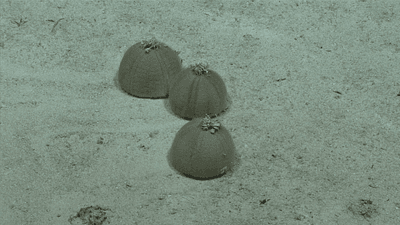


It’s a rare and magical thing to get to dive under the waves in a remotely operated vehicle (ROV) and see what all the sea creatures are getting up to without our knowledge. Hardly surprising, then, that sometimes such expeditions turn up some astonishing scenes. Case in point: a sea urchin hat party.
In 2022, during dive 08 of the third Voyage to the Ridge expedition by NOAA's Okeanos Explorer, the ROV Deep Discoverer descended into waters near St. Croix in the Caribbean. At a depth of 411 meters (1,348 feet), it stumbled upon a scene few have ever witnessed.
"A Victorian hat party"
Deep Discoverer had crashed a large gathering of the sea urchin Conolampas sigsbei. There’s a lot to love about these deep-sea urchins. They are dumpy and round with short spines, setting them apart from other spiky urchins. To quote the NOAA, if you imagine a “steamed bun” shuffling along the seabed, you’re not far off.
Known as tan sea urchins, they’re rarely seen in the wild because they prefer depths of around 277-540 meters (909-1,772 feet). That said, they do leave a distinctive trail in their wake, so when the NOAA scientists spotted loads of them all in one place, they had a feeling something exciting was going down.
Sure enough, they found themselves in the thick of a tan urchin meet-n-greet. There were at least 35 individuals spread out over a distance of several meters in what was most likely some kind of mating aggregation.
Urchins reproduce via spawning, whereby they release sperm and eggs into the environment so that they can fertilize in the water. This means the urchins don’t have to be touching to get it on, but it’s helpful to be in a group if you want to capitalize on fertilization opportunities. More urchins = more gametes, but that's not all they bring to the party.
What's with all the hats?
Like many urchins, tan urchins are known for a strange hat-wearing behavior. In science, it’s known as “collecting” and sees the urchins using their spines to pull objects from the environment onto their body surface – often wearing them on top, which is why it ends up looking like a hat.
They look dapper AF, certainly, but what benefits do these hats offer the urchins?
There are a few possible explanations, and their likelihood varies depending on where the urchin in question lives. Camouflage is a pretty universal benefit, whereas urchins in shallower regions may also have the added bonus of blocking out UV rays from sunlight. Covering their bodies with debris may also protect their genital pores, which are on the top.
That there remain so many unknowns about why these sea urchins would gather like this, and with so many hats, reflects just how rare an observation it was. You can hear the excitement in the delighted voices of the scientists operating the ROV, and I quote:
“There is just so much about this that is magic.”



 1
1