Nature
 PUBLISHED
 4
4


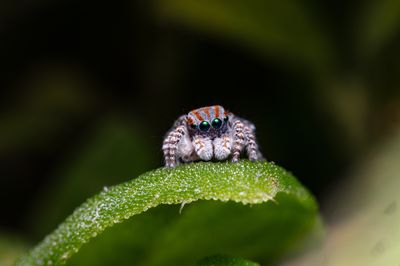


Arachnophobia is a pretty common condition, but it can have serious wider implications for a person’s health and wellbeing, their enjoyment of nature, and more broader knock-on effects for spider conservation programs. To try and understand why some people are disgusted by and afraid of spiders, a new study tracked people's eye movements to see what frightens them the most.
The team recruited 118 undergraduate students for the study and had them focus on image pairs that featured, in the first part of the experiment: “(1) spider versus butterfly, (2) spider versus insect, (3) spider eyes versus insect eyes, (4) spider versus non-spider arachnid, and (5) spider versus myriapod (centipedes and millipedes),” explain the authors.
The spiders in these images all had different degrees of hairiness and fangs, along with the variable presence of webs and eggs.

“If I know what turns people off about arachnids, that can help me figure out how to avoid those things and focus on things that might turn people on about arachnids,” said principal investigator Eileen Hebets, George Holmes Professor of biological sciences in a statement.
The second comparison involved scorpion and non-scorpion pairs, to see how the participants compared spiders to other arachnids. There is some suggestion that a fear of spiders is a fear of all arachnids, which the authors wished to explore.
The final part of the study was a comparison between two images of spiders with different appearances, i.e. one very hairy and one much less so, or one with a web and one without.
During the photo comparisons, the participants' eye movements were tracked. There were four eye-tracking measures used in the study to better understand what drew their attention the most: dwell time was the amount of time spent on each image; first run dwell time, the amount of time looking at an area of interest in an image the first time they saw it; first fixation time, the amount of time that passed between the start of the trial and the first time the eye was settled looking at an image; and run count, the number of times a participant looked again at one image.
The results showed that the participants were quicker to look at images of butterflies over images of spiders. They also looked for longer and more often at images of insects, other arachnids, and myriapods compared to images of spiders. Overall, there was a general avoidance of the spider images – when two images of spiders were shown, the attention was mostly on a spider-specific feature, such as if they were shown in a web.
“When I talk to people about their fear of spiders, one of the first things they mention is how fast they are and how unpredictably they move,” Hebets said. “It makes a lot of sense to me that people might be less afraid of a spider in a web than one on the ground, because of the predictability.”
The team hope their research can be built upon to help understand more about arachnophobia, especially in cases where the phobia can be extremely limiting.
The study is published in Frontiers in Arachnid Science.