Space and Physics
 PUBLISHED


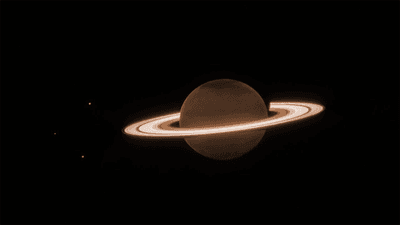


A new study simulating Saturn's past suggests its rings may have formed following the breakup of a hypothetical moon dubbed "Chrysalis", around 100 million years in the planet's past.
Saturn is believed to have formed within around 10 million years after the Sun's own formation, and shortly behind our largest gas giant Jupiter. It was assumed that its distinctive rings – made of particles of rock and ice – were formed at the same time, around 45 billion years ago.
But then we got a closer look, when NASA's Cassini spacecraft reached the gas giant in 2004. Rocky bodies in the Solar System generally encounter a lot of dust. If Saturn's rings were formed all that time ago, you would expect that the rings would end up covered in a significant amount of dust in the meantime. When NASA saw them up close, however, they found that they were surprisingly clean, and contained around 98 percent pure water ice by volume.
“It’s almost impossible to end up with something so clean,” lead author of one 2023 study attempting to age Saturn's rings, Sascha Kempf from the University of Colorado Boulder, explained in a statement. “Think about the rings like the carpet in your house. If you have a clean carpet laid out, you just have to wait. Dust will settle on your carpet. The same is true for the rings.”
There have been a few suggestions for how this came to be. One is that the rings formed a lot more recently in the planet's past than we thought, perhaps via the breakup of a moon, dubbed Chrysalis, shredded apart by tidal forces as it roamed too close to the gas giant. In a new paper presented at the Lunar and Planetary Science Conference in Texas, a team has investigated this hypothesis a little further, applying models to see if Chrysalis could produce the right kind of mass and material to explain Saturn's rings.
The team modeled these tidal disruption events, making a few assumptions about Chrysalis, and attempted to see if they would cause Saturn's ring system, and yield clues which scientists could then look for in the gas giant.
"Chrysalis could be as massive as Iapetus and likely differentiated; we model it as a mantle-core-layered body with its initial density and pressure profiles in hydrostatic equilibrium," the team explains in their paper. "The mantle is assumed water ice and the core is silicate."
Looking at the simulations, the team found that the scenario was plausible, with some disruption events producing huge amounts of ice
"Chrysalis has a periapsis that lies between the disruption limits for ice and rock. In such scenarios, tide forces are strong enough to remove mass from the icy mantle but insufficient to disrupt the rocky core," the team explains. "Most of the rock particles are still retained in the largest remnant, which experiences only minor orbital changes relative to the pre-encounter orbit of Chrysalis."
The ice particles in this scenario break up into two populations, with one population being ejected whilst the other goes on to form the rings of Saturn. Whilst already showing off as they look today, closer to the impact event the rings may have been even more spectacular.
"The post-encounter ring particles are subject to perturbations of Saturn’s large moons, such as Titan, which can remove as much as 70 percent of total mass, so the ring mass originally stripped must have been several times larger than present," the team writes. "We conclude that tidal stripping of a differentiated Chrysalis can produce a ring with both mass and composition resembling the present rings."
Though interesting, and good to know that an impact scenario is possible, this is not the final word on the topic. The team suggests that in future they could look for potential impacts of stripped particles on Saturnian moons (and there are a lot of them) for evidence of such an event. Alternative suggestions include that Saturn's rings really did form with the planet, but just look younger as impactors don't leave them as dirty as you'd think. Further study is needed, but either scenario is pretty cool.
The paper was presented at the Lunar and Planetary Science Conference 2026 in Texas.