Space and Physics
 PUBLISHED
 1
1



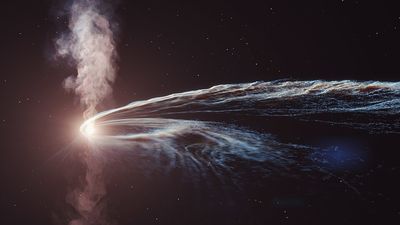


Supermassive black holes can be very bright if they are actively eating, usually a brightness that stays there for a very long time. They can also be occasionally bright when they rip apart a star, delivering a flash of light as the star is reduced to plasma. Supermassive black hole AT2018hyz, also known as Jetty McJetface, seems to be doing something different. It destroyed a star in 2018, and now it is getting brighter and brighter.
Stellar destruction in this way is known as a tidal disruption event. Many of these events have been witnessed and, to be fair, AT2018hyz was nothing unusual. Standard, run-of-the-mill, death of a star by a supermassive black hole. That was back in 2018. The following year, things started getting strange.
The supermassive black hole appears to have released a jet of material, something that they are known to do, but the jet is getting brighter and brighter. Radio observations suggest that it is now 50 times brighter than it used to be in 2019, and it is among the brightest known events in the universe.
“This is really unusual,” lead author Yvette Cendes, an astrophysicist at the University of Oregon, said in a statement. “I'd be hard-pressed to think of anything rising like this over such a long period of time.”
The first hint of things being unusual was seen in follow-up observations in 2022, and this new work suggests that somehow the black hole keeps getting brighter. Researchers have created a model to explain what’s going on, and they think the system will peak in 2027.
Still, it is an outstanding event. The team was able to calculate the current energy outflow, and it is truly an enormous number. This supermassive black hole is releasing energy similar to gamma-ray bursts. Just why the supermassive black hole had such a delayed response remains a mystery.
“If you have an explosion, why would you expect there to be something years after the explosion happened when you didn't see something before?” Cendes added.
Now that the team knows that events such as this exist, they are looking for more of them. Finding a population could help us understand why supermassive black holes would have a delayed reaction to the destruction of a star.
The study is published in The Astrophysical Journal.