Nature
 PUBLISHED
 2
2




More things than you would think fall out of the sky at seemingly random intervals. Pieces of meteorite in Germany and frozen igunanas have all hit the deck in the not-too-distant past. Now, however, 200 parrots have dropped from the skies, and scientists aren’t quite sure why.
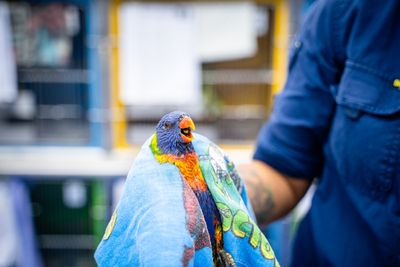
In northern New South Wales, Australia, around 200 rainbow lorikeets (Trichoglossus moluccanus) dropped from the skies near Grafton. The birds were swiftly rescued and taken to wildlife centers to be cared for; however it is thought that 40 percent of the birds won’t survive their illness.
It seems the parrots were suffering from an illness known as Lorikeet Paralysis Syndrome (LPS), causing varying degrees of paralysis in their legs and wings. What is baffling to scientists is that the disease has no known trigger, so it is difficult to work out why these birds were suddenly affected and in such high numbers.

"It's a significant animal welfare issue and crisis. These animals suffer terribly before they die or get killed by a cat or a possum finds them," David Phalen, a professor of wildlife health and conservation at the University of Sydney, who works on the Lorikeet Paralysis Syndrome Project, told ABC.
This is not the first time such a incident has happened, with birds regularly having to be cared for and nursed back to health in wildlife centers, especially in the months of December, January, and February — the Australian summer.
"A lot of them don't make it because when they come in, they are underweight and malnourished and very sick birds," said Robyn Gray, the Clarence Valley avian coordinator for the Wildlife Information, Rescue and Education Service (WIRES).
While researchers and scientists have been looking into the disease since it was first identified in 2010, as yet no environmental element or pathogen has been identified as the cause.
"We've got professors in Sydney, Currumbin and Australia Zoo, Sydney Uni, all testing them and no one can really give a definitive answer,” continued Gray.

According to Animalia, rainbow lorikeets mainly eat nectar from flowers, but will also consume berries and fruits as well as visiting garden feeders. One theory suggested that the birds were getting drunk on fermented fruit such as mangoes, which was causing them to fall from the sky, but this has been debunked. However, the possibility that a toxin in pesticides could be causing the LPS is still being considered.
"We have tested for alcohol, and we have not found any alcohol in their system, and the signs we are seeing are not consistent with alcohol poisoning," said Phalen.
Further testing on pesticides and toxins on the fruit has yet to reveal any conclusive cause. Since the paralysis typically occurs during set months, others believe it could be something within the fruit that causes this disease, creating a pathogen or substance toxic to the parrots as it ripens.
"Not all fruits they're eating are necessarily toxic, so it could be a toxin forming inside them, possibly because the [fruit is] going off," Phalen said. "We still think there might be some toxins out there that we haven't tested for and that will be the focus of our investigation this year."

According to the Queensland Government, the lorikeets might not be the only animals affected by this problem. A species of bat known as the flying fox (genus: Pteropus) are also being found on the ground, presenting wildlife veterinarians with similar symptoms.
"Basically, bats are the lorikeets of the night," Jane Hall, wildlife health project officer at Taronga Conservation Society Australian told Scientific American. “Whatever the lorikeets are feeding on in the daytime, the bats are feeding on in the nighttime. So it’s really interesting that the bats are presenting with similar clinical signs.”
Whatever the cause of this horrible and mysterious illness, we hope the researchers are able to find it soon.
This article was amended to include photographs of the lorikeets, courtesy of RSPCA Queensland.