Nature
 PUBLISHED
 1
1



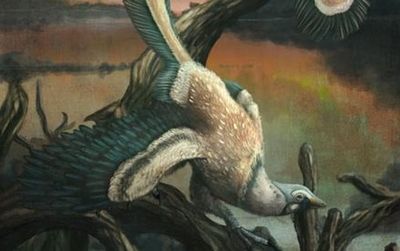


What you’ll discover in this article
- There have historically been two hypotheses as to how birds evolved flight: tree down or ground up.
- Most modern birds do a little hop to get into the air, leading palaeontologists to wonder if this might be a clue to how they first got started.
- Dr Neil Gostling tells IFLScience that “flight wouldn’t have been something that these animals were intending to do. It's a by-product of everything.”
Flight is one of the defining characteristics of birds, and it's also an extremely complicated way of getting about, in terms of the coordination and adaptations required to get off the ground. So, while we know birds evolved from bipedal dinosaurs called theropods, we're less clear on how they passed all the steps that allowed them to launch themselves into the skies.
Now, by studying the behavior of birds and the biomechanics of the legs of the proto-bird Archaeopteryx, researchers have come to a new conclusion: perhaps the first birds were hopping about, instead of flapping.
More than two ways to get into the air?
There are, generally speaking, two main hypotheses as to how our feathered friends first took to the skies.
The first of these is what is known as the “trees-down” approach. This suggests flight first evolved from gliding behavior, in which early proto-birds would have clambered to the tops of trees and then launched themselves into a controlled glide, not unlike a flying squirrel.
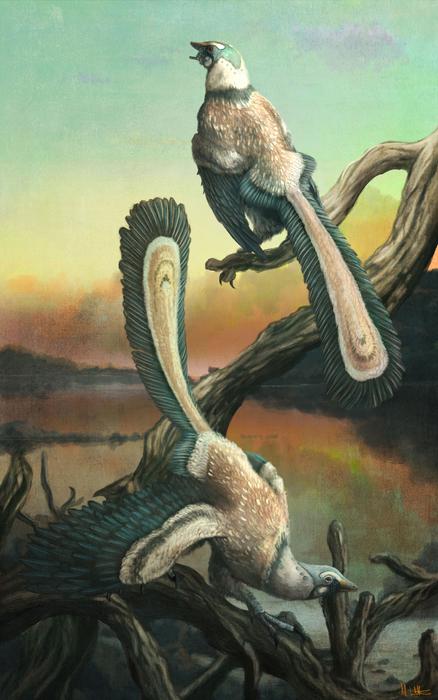
The other is called the "ground-up" hypothesis. As the name suggests, this instead works on the idea that these early Maniraptoran dinosaurs were running along the ground trying to catch prey in their grasping hands, when instead they caught some air.
“The problem with that is that then you don’t catch your food,” Dr Neil Gostling, a palaeontologist at the University of Southampton in the UK and co-author of this latest study, told IFLScience. “So if every time you’re running along trying to catch food and you suddenly take off, that’s going to be a bit bad.”
Having occurred so far in the distant past, these hypotheses are almost impossible to test. However, when the late Colin Palmer was watching some modern dinosaurs – also known as birds – pottering around on the ground, he noticed something intriguing. Most of them didn't launch straight into the air to take flight; instead, they would do little hops to build up some speed.
Palmer then got in contact with Gostling and his colleague Professor Markus Heller, also at Southampton, to see if the idea had any legs.
“The hypothesis that we had was that if you are a small theropod dinosaur, you’ve got big powerful legs, but you would also make a tasty snack for a larger dinosaur,” explains Gostling. “And so if you can jump out of the way, you don’t get eaten.”
Perhaps, then, flight evolved not as a means to catch prey, but instead to avoid being prey. “Flight wouldn’t have been something that these animals were intending to do. It's a by-product of everything,” said Gostling.
Testing the hop
While testing whether early proto-birds such as Archaeopteryx would have glided is impossible, Gostling and Heller were able to look at whether the ancient animal could hop, and at what speed.
Using a dataset collected by Dr Pauline Provini at the Paris Natural History Museum, the first step was to model the biomechanics of living birds and how they manage to bounce before flying.
“We wanted to apply that principle to a living bird and to see, firstly, whether we are actually able to measure all that stuff that we need to measure,” Heller told IFLScience. “Can we actually find and predict that the bird can clearly take to the air?”
Once they were able to do this, they turned their attention to Archaeopteryx fossils.
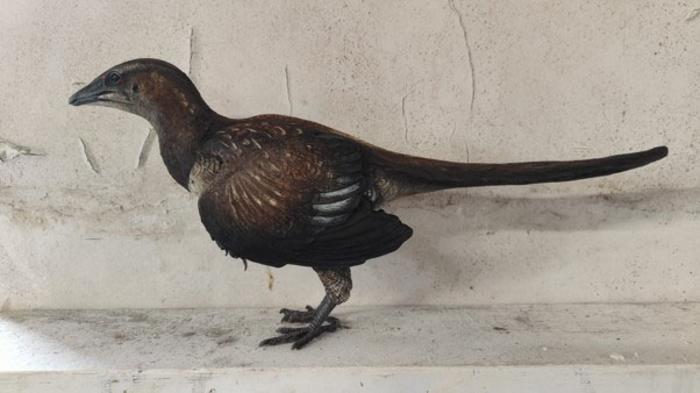
As something of a poster boy (or girl?) for evolution, Archaeopteryx is one of the most famous and important ancient species ever discovered. Showing a mix of dinosaur-like and bird-like anatomy, it had sharp pointy teeth and claws, but also gloriously feathered arms and a feathered tail.
Once a behavior has happened and it confers an advantage, then everything down the line in the lineage is going to do that
Neil Gostling
Crucially, however, it probably didn’t have the capacity for powered flight. It lacked the bones in the chest needed for strong muscle attachments for flapping its wings, but it did have rather chunky legs.
Applying the same modeling and biomechanics they figured out for living birds to the fossil dinosaur, the researchers were able to see that yes, Archaeopteryx would have been able to hop quickly enough to get airborne. But they likely needed an extra step.
“This is then where we came to this realization that, well, they would not have been able to do this in one go,” says Heller. “But with a series of hops, they would eventually be able to reach the velocity that they needed in order to fly away.”
Literal step-by-step evolution
Maybe, then, rather than flight evolving as a means to get from one place to another, it was co-opted from a behavior that evolved to avoid becoming the snack of larger animals.
As a result, it could mean that if you were to travel back to the time of Archaeopteryx some 150 million years ago, you might have been able to observe them hopping about like crows do today.
“I’m an evolutionary biologist,” said Gostling. “I get incredibly frustrated when people look for design in things, because there isn’t.”
“These things happen by chance. And the thing is that once a behavior has happened and it confers an advantage, then everything down the line in the lineage is going to do that and it's going to look like it was planned. But it’s a selection bias. All the things where it didn’t work, they’ve gone and they’ve disappeared. They’ve gone extinct.”
The researchers are keen, however, to stress that while they’ve shown it would have been possible for these early birds to get into the air by hopping, their results don't preclude any other hypothesis from also having a role to play.
“We’re not saying that any of these other things aren’t right,” says Gostling. “They’re not quite so easy to test.”
“I think it was not for us to say that all these others are wrong,” adds Heller. “It was just we want to say that this is an obvious theory that no one has really looked into.”
The research has been published in the journal Developmental Biology.