Nature
 PUBLISHED


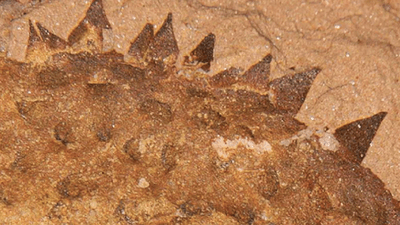


Do you ever find yourself wondering what prehistoric slugs would’ve looked like? Yeah, us too. It’s hard to place them on the ancient Earth and picture how they first appeared: Were they huge? Were there shells? Does a gooey slug even fossilize? Turns out the answer is no, no, yes, as demonstrated by an incredible fossil slug that’s half a billion years old.
The fossil is Shishania aculeata, a new-to-science species of ancient armored slug that dates back to the early Cambrian. It was covered in hollow cone-shaped spines that – remarkably – are preserved in fossil form, enabling scientists to establish that they were created through a sophisticated secretion system that’s seen in worms.

That’s not to say the discovery of this slug species was easy, however. Shishania was soft, small, and made up of tissues that don’t typically preserve in the fossil record, and yet fossils were retrieved from eastern Yunnan Province in southern China. They weren't perfect, and they were quite small, which meant working out what they were looking at saw the team go through some nicknames before settling on the grander scientific title.
“At first I thought that the fossils, which were only about the size of my thumb, were not noticeable, but I saw under a magnifying glass that they seemed strange, spiny, and completely different from any other fossils that I had seen,” first author Guangxu Zhang, a recent PhD graduate from Yunnan University in China who discovered the specimens, said in a statement. “I called it ‘the plastic bag’ initially because it looks like a rotting little plastic bag. When I found more of these fossils and analysed them in the lab I realised that it was a mollusc.”

From the plastic bag to Shishania aculeata, its name is a hat-tip to Shishan Zhang for his contributions to the study of early Cambrian strata and fossils in eastern Yunnan, and the Latin aculeata that refers to it having spines. That prickliness is the presentation of cones known as sclerites made of chitin, a material that’s also found in the shells of crabs, insects, and even some mushrooms.
The discovery reveals that the most primitive mollusks were these shell-less slugs with flat bodies that were protected by prickly armor. And as we see in the incredible diversity of gooey shelly things alive today, from here, the mollusks really took that basic body plan and ran.
“Trying to unravel what the common ancestor of animals as different as a squid and oyster looked like is a major challenge for evolutionary biologists and palaeontologists – one that can’t be solved by studying only species alive today,” added corresponding author Associate Professor Luke Parry, Department of Earth Sciences, University of Oxford. “Shishania gives us a unique view into a time in mollusc evolution for which we have very few fossils, informing us that the very earliest mollusc ancestors were armoured spiny slugs, prior to the evolution of the shells that we see in modern snails and clams.”
The study is published in the journal Science.


 1
1