Nature
 PUBLISHED
 1
1


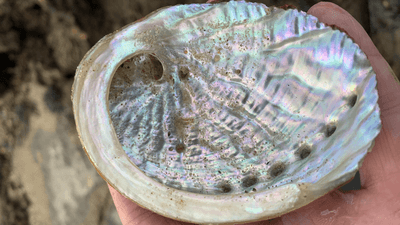


An abalone identity crisis has finally found a solution thanks to hardworking scientists in New Zealand. Found off the Manawatāwhi/Three Kings Islands, it had long been suspected the small abalone was unlike any other, but it took a deep dive into its DNA to finally settle the debate.
These precious sea creatures are considered treasure in New Zealand, but to look at them you might not realize they're a kind of snail. So, what is an abalone? And why are they so adored?
What is an abalone?
Abalone is an umbrella term for a group of marine snails, only they don’t look like your typical snail because they have a flattened spiral shell. Their other common name is pāua, and they can range from the size of a button to a beret. Now that’s some range.

Pāua hold special importance in New Zealand where they’re considered taonga (national treasure). They’ve been used in everything from fishing, to carvings, art, and jewelry, owing to the beautiful iridescence of their shell interiors.
Why is abalone shell iridescent?
The abalone shell gets its beauty from light being split by Bragg diffraction. This is due to the layers of nacre that coat its shell and vary in thickness with each growth cycle, giving rise to a rich array of colors.

You may recognize it as mother of pearl, but it's just one of several shells that boast this iridescent display. Abalone are also a target species in aquaculture for their pearls, being one of the few gastropods that can make them.
Abalone pearl
An abalone pearl is created in a similar way to that of an oyster, building up layer by layer as nacre accumulates around a nucleus. Abalone pearls may differ due to the snail’s anatomy, however, often having less uniform shapes and a stunning blue hue.

If you’re hoping to find an abalone pearl out in nature, might we encourage you to think again. According to a 2024 paper, approximately one in 100,000 abalone form a natural pearl. Most of those you’ll find on the market are engineered through seeding, where an artificial nucleus is sewn into the abalone that then gets encased in nacre before being retrieved several months to years later.
Who is this new species of abalone?
Meet Manawatāwhi pāua, Haliotis pirimoana, whose name means “the pāua that clings to the sea”. Researchers had long been pondering if this small abalone might be different from other species, and they were able to confirm their suspicions by extracting ancient DNA from shells.
“Species discovery is seldom punctuated by a clear ‘Eureka!’ moment,” explained the scientists behind the discovery for The Conversation. “More often, it’s a muted thought that something looks a little different. So it was with the discovery of the Manawatāwhi pāua.”

With a modest size of 40 millimeters (1.6 inches), they say the abalone isn’t at much risk of being targeted commercially and probably isn’t in need of conservation attention. However, it’s a precious discovery as it represents another taonga found in Aotearoa New Zealand, and one that can be the pride of Manawatāwhi specifically.
Abalone are remarkable marine snails for their pearl-producing skills, but they're by no means the most bizarre. Have you ever seen the biggest snail in the world?