Nature
 PUBLISHED


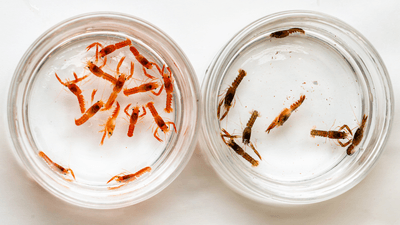


Peaches the famous orange lobster has welcomed a bumper crop of tiny baby lobsters. Being a 1-in-30 million lobster herself, Peaches’ clutch includes over a dozen of a rare variety, and they've joined the offspring of a second mother lobster, Norma, as the subjects of a research project.
The mega family of mini babies calls the University of New England home, a place that’s no stranger to rare lobster news. It houses an impressive line-up of exceptional individuals, including blue, orange, yellow, split-colored, purple, and calico varieties of lobsters, whose rarity ranges from 1-in-1 million to 1-in-50 million.
Quite the catch!
Parent Peaches is the proud mom to 100 baby lobsters, meanwhile Norma has a more modest army of 40. Their offspring will hopefully soon be joined by the babies of Pineapple, another rare orange lobster like Peaches who is also housed at UNE.
The babies are drawing quite some attention, now the subjects of a project shared by UNE students and faculty. They’ll be monitoring the growing lobsters to see how many match the rare parents’ colorations.

The goal is to search for a genetic basis for these animals’ colorations. At current, the precise genetic mechanisms that cause some lobsters to eschew the traditional brown/mottled appearance in favor of something more jazzy aren’t known, but these babies could bring us closer to finding out.
“At this point, no one really knows in detail why some lobsters develop these multicolor variations, though we do have some theories,” UNE’s Dr Markus Frederich, professor of marine sciences, said in a release. “We hope to use this gene expression research to study the molecular biology of these creatures in a way that is not harmful to the lobsters.”

Other rare lobster specimens come in yellow, blue, and white. The odds of catching a blue lobster are 1-in-2-million, and both blue and yellow lobsters are the result of a genetic mutation in the proteins that bond with shell pigments.
Golden lobsters like this latest addition and Banana are only pipped to the rare lobster post by 1-in-100 million "crystal lobsters" that have a pigment condition called leucism. Interestingly, they're the only wacky lobster variety that doesn't turn red when cooked, which in typical specimens is the result of shell proteins unwinding in the heat and releasing the pigment molecule astaxanthin.
Lots of tricks hidden up those lobster claws.

 1
1